
A/B testing patient intake flows: what to test and how to read results
What to A/B test first in a patient intake flow, how to size a test without guessing, how to read step-level results, and how to keep PHI out of testing.
Written for growth leads, product managers and operators at telehealth and DTC health brands
To A/B test a patient intake flow well, change one thing at a time against a control, decide how many completed visits you need before you start, and compare the variants step by step rather than on one overall conversion rate. Start with the changes that move the most patients: question order, how long each step is, the copy on the hardest screens, when the price appears, and where consent sits.
This guide covers what to test first, how to size a test without guessing, how to read the results at the step level, and how to run tests without sending health answers into a testing tool.
What is A/B testing an intake flow?
An A/B test shows two versions of the same flow to comparable groups of visitors at the same time. Version A is the control, the flow you run today. Version B differs in one deliberate way. Everything else stays the same: the traffic source, the offer, the eligibility rules set by your clinicians, the checkout.
Intake flows are a good fit for testing because they are long, structured and measurable. A typical telehealth intake has a goal question, an eligibility screen, a medical history section, consent, a recommendation and checkout. Each of those is a step where people leave. A test tells you whether a specific change makes fewer of them leave at that step, and whether that holds all the way to the end.
There are two things an intake test is not:
- It is not a clinical change. Who qualifies, which answers disqualify, and which questions a clinician needs are decided by the brand’s medical team. You can test how a question is asked and where it sits. You do not test whether to ask it.
- It is not a redesign. If version B changes the headline, the step order and the button color at once, a win tells you nothing you can reuse.
What to test first
Not every change is worth a test. Start where a change can plausibly move many patients, and where you have a reason to believe it will. Your step-level drop-off data is the best source of ideas: the step with the steepest drop is usually the first place to look.
| Test | What changes | Why it can matter | Step to watch |
|---|---|---|---|
| Question order | Goal question first vs. eligibility first | Asking what the person wants before asking about their health builds commitment | First three steps |
| Step length | One question per screen vs. grouped questions | Long screens feel like paperwork; very short ones feel endless | The long medical history section |
| Copy on hard questions | A short line explaining why a sensitive question is asked | Unexplained sensitive questions are a common exit point | The sensitive step itself |
| Price reveal timing | Price shown early vs. after the recommendation | Showing price before value can lose people who would have paid | Recommendation and checkout |
| Consent placement | Consent at the start vs. right before it applies | Consent in context reads as care; consent up front reads as legal friction | Consent step and the one after |
| Contact capture | Email asked early vs. later | Early capture allows follow-up on drop-offs but can cost starts | Contact step |
Question order
The order in which you ask questions changes how the flow feels. Many brands open with a goal question (“What would you like help with?”) before any medical screening, because it frames the rest of the flow around the patient. Others put a short eligibility check first so ineligible visitors leave quickly. Both are defensible, which is exactly why it is worth testing. Our guide to patient psychology in intake flows explains the reasoning behind common orderings.
Price reveal timing
When the price appears is one of the largest structural choices in a telehealth funnel. Showing it early filters out people who would never pay. Showing it after a recommendation lets people see what they would get first. Test the timing, and judge it on paid checkouts, not on intake completions. Our guide to a telehealth intake funnel that converts walks through where price usually sits.
Consent placement
Consent cannot be skipped, but it can be placed. A consent step at the very beginning, before the person has invested anything, is a common exit point. Placing consent right before the step it applies to (for example, before photo upload or before the telehealth consult) keeps the same legal content in a more natural place. Have your clinical or legal team approve both versions before the test starts.
Change one thing at a time
The single most useful rule in intake testing is one change per test. If version B moves the price, rewrites the headline and removes a step, and it wins, you do not know which of the three did the work. Worse, one change may have helped while another hurt.
In practice:
- Write the hypothesis in one sentence before you build: “Moving consent to just before photo upload will raise completion of the consent step without lowering paid checkouts.”
- Name one primary metric (usually paid checkouts or completed intakes) and the one step where you expect the effect.
- Keep the traffic the same for both variants. Do not start a new ad campaign halfway through.
- If you want to test a larger redesign, test it as one change on purpose, and accept that a win tells you “the new flow is better” and nothing more specific.
How many visitors you need before you call a result
The sample size you need depends on three things: your current conversion rate at the metric you care about, the smallest improvement you would act on, and how much risk of a false result you accept. A small improvement on a low conversion rate needs far more visitors than a large improvement on a high one.
There is no universal number, and anyone who quotes one without your baseline is guessing. Use a calculator. Evan Miller’s sample size calculator asks for your baseline conversion rate, the minimum detectable effect, statistical power and significance level, and tells you how many visitors each variation needs. Do this before the test starts and write the number down.
Then hold yourself to it. Checking results every day and stopping the moment one variant looks significant inflates false positives. In his article on how not to run an A/B test, Evan Miller simulates a test where the change has no real effect, checked after every observation, and reports false positives 26.1% of the time against an intended 5%. His fix is simple: fix the sample size in advance and do not act on results until you reach it.
Two practical consequences for intake:
- Low-volume brands should test bigger changes. If you get a few hundred starts a week, a test aimed at a tiny lift may never finish. Test changes you expect to matter a lot, such as price timing or step order.
- Run whole weeks. Visitors on a Sunday night can behave differently from visitors on a Tuesday morning, and ad delivery shifts over the week. Run tests in full weekly cycles even if you hit your sample size sooner.
Reading the results
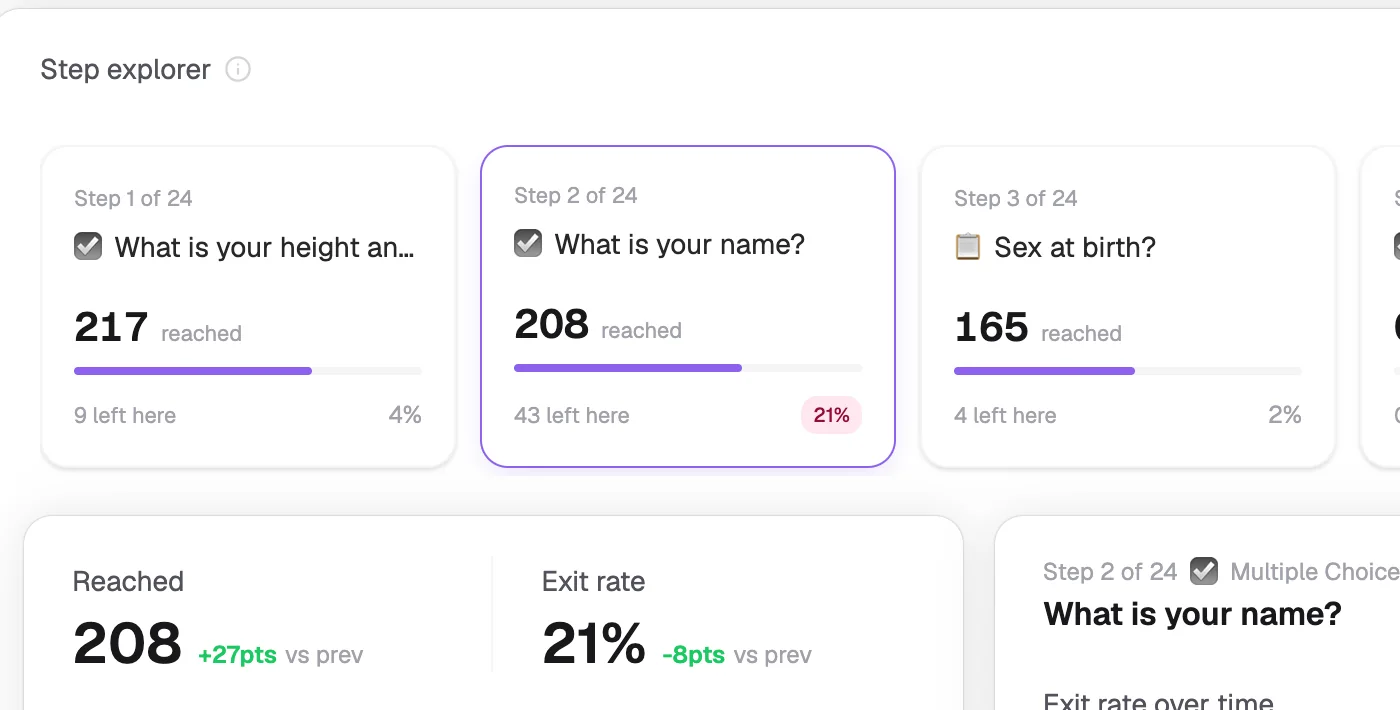 Step-level completion: the number you compare between variants.
An overall conversion rate tells you which variant won. Step-level completion tells you why, and whether the win is real.
Read a finished test in this order:
- The primary metric. Did paid checkouts (or completed intakes) differ between A and B by more than your planned minimum, at your planned sample size? If not, the honest answer is “no detectable difference”, and that is a result.
- The step where you expected the effect. If you moved consent, did completion at the consent step change? A win in the primary metric with no change at the expected step is a reason to be suspicious.
- The steps after it. A change can move drop-off downstream instead of removing it. Splitting a long screen may raise completion there and lower it two steps later. Compare every step from the change to the end.
- Eligibility outcomes. If version B produces more completions but a larger share of them are routed to the ineligible path, it has not helped. Compare how many eligible patients reach checkout in each variant.
- Segments, carefully. Mobile vs. desktop and traffic source are reasonable cuts. Slicing into many small segments after the fact will find a “winner” by chance; treat segment findings as ideas for the next test, not conclusions.
When a test wins, make the winner the new control. When it loses or ties, keep the control and log what you learned.
Keep PHI out of your testing setup
Intake answers are health information. A testing setup that copies those answers into a third-party experimentation or analytics tool can turn a growth test into a privacy problem. The risk is real: in 2023 the FTC took action against BetterHelp, alleging it revealed consumers’ email addresses, IP addresses and health questionnaire information to Facebook, Snapchat, Criteo and Pinterest for advertising, and the proposed order required it to pay $7.8 million to consumers.
A PHI-safe test follows a few rules:
- The test reads step events, not answers. To compare variants you need to know which variant a visitor saw and which steps they completed. You do not need what they answered.
- No client-side testing script that sees the page content. Tools that rewrite the page in the browser can read what the patient types. If you use one, check exactly what it collects and whether the vendor will sign a BAA.
- Ad platforms get conversions, not answers. If you report test outcomes to ad platforms, send only consented, hashed identifiers and the conversion event. Our Data Platform is built around that rule, and the HIPAA page explains what PathwAI signs and stores.
How to do it in PathwAI
PathwAI runs intake tests inside the same tool that builds the flow, so the test, the flow and the step-level numbers live in one place.
- Build or open the control. Your live flow on the visual builder is the control: eligibility, intake, consent and checkout steps on one canvas with routing on any answer.
- Create the variant. Add a variant of the flow with your one change: reorder steps, edit copy on a screen, move the consent step, or change a routing rule. If you want a starting point, the AI agent can draft a variant from a plain-English description; it stays a draft until your team approves it.
- Review before it goes live. Share a preview link with your clinical or legal reviewer, especially for any change near consent or eligibility.
- Run the test against the control. Analytics and A/B testing lets non-technical teams test copy, step order or routing against a control without engineering.
- Read it step by step. PathwAI reports completion and drop-off for every screen in each variant, so you can compare the step you changed and every step after it.
- Report conversions safely. If the test feeds ad optimization, the Data Platform sends conversions server-side to Meta, Google Ads, TikTok and Microsoft Ads with hashed identifiers, PHI stripped, and only for visitors who consented.
Intake testing checklist
- The hypothesis is one sentence, naming the change, the step and the metric.
- Only one thing differs between control and variant.
- The sample size per variant is calculated and written down before launch.
- The test runs for whole weeks on unchanged traffic.
- Clinical or legal has approved any change to consent wording or placement.
- Eligibility rules are identical in both variants.
- The testing setup records variants and steps, not answers.
- Results are read at the primary metric, the changed step and every step after it.
- The outcome, win, loss or tie, goes in the test log.
Frequently asked questions
What should a telehealth brand A/B test first in its intake flow?
Start with the step that loses the most people in your step-level data, and test a structural change there: question order, step length, price reveal timing or consent placement. Copy on sensitive screens is a cheap second choice.
How long should an intake A/B test run?
Until each variant reaches the sample size you calculated before launch, and for at least one full week, ideally whole weeks. Do not stop early because one variant looks ahead.
Can we A/B test eligibility questions?
You can test how an eligibility question is worded and where it appears. Whether it is asked, and which answers qualify, is set by your clinicians and should be the same in both variants.
Is it safe to use a general A/B testing tool on a patient intake?
Only if you know exactly what it collects. A tool that reads the page in the browser can see health answers. Prefer testing that records variants and step completions only, and check whether the vendor signs a BAA.
What if the test shows no difference?
Then the change does not matter enough to detect at your volume. Keep the control, log the result, and test a bigger change next.