
Best HIPAA-compliant marketing analytics and attribution tools (2026)
Eleven HIPAA-ready analytics and attribution tools grouped by category, with the plan that carries the BAA, pricing, a real limitation and how to choose.
Written for growth and marketing leads at telehealth and DTC health brands who need ad attribution without sending PHI to ad platforms
The best HIPAA-compliant attribution tool is the one that fills the gap you actually have, signs a BAA on the plan you will buy, and keeps health data away from ad platforms. If you run paid traffic into an intake or eligibility flow, PathwAI does both jobs in one product: it builds the flow and sends hashed, consent-gated conversions to Meta, Google, TikTok and Microsoft. If you only need to replace pixels on an existing site, look at Freshpaint, Ours Privacy or Curve. If calls are your main conversion, look at CallRail, Invoca or Liine.
Most lists rank these tools against each other, but a web analytics suite, a call tracker and a data pipeline do different jobs. Below, eleven tools are grouped by category. Every BAA and price comes from the vendor’s own website as of October 2026.
Quick picks
| Tool | Category | Best for | BAA | Pricing |
|---|---|---|---|---|
| PathwAI | Intake builder with a built-in Data Platform | Brands sending ad traffic into intake, eligibility and checkout flows | Enterprise plan | Quote; Data Platform priced by monthly tracked users |
| Freshpaint | Data governance and routing | Healthcare marketing teams replacing pixels across a whole site | Offered (plan not stated publicly) | Quote (Comply, Perform, Scale) |
| Ours Privacy | Data governance and routing | Teams that want a BAA on the entry plan | Every plan | Quote, tiered by monthly tracked users |
| Tealium | Data governance and routing (enterprise CDP) | Large organizations with an existing Tealium or enterprise stack | Private Cloud customers | Quote |
| Curve | Server-side ad conversions | Practices and telehealth brands that only need conversions fixed | Every plan, no extra cost | Quote, usage-based |
| Piwik PRO | Web analytics | Teams replacing Google Analytics with a full suite | Healthcare Enterprise plan | From $30,000 a year |
| Matomo On-Premise | Web analytics (self-hosted) | Teams with engineers and their own HIPAA hosting | Not needed with Matomo; needed with your host | Free software; you pay for hosting |
| CallRail | Call tracking | Practices where the phone is the main conversion | Healthcare plan | From $150 a month |
| Invoca | Call tracking and conversation intelligence | Health systems with large call volumes | Offered to covered entities | Quote |
| Liine | Call tracking and booking attribution | Multisite healthcare and dental groups | All packages | Quote |
| Improvado | Marketing data pipeline | Teams that report spend and outcomes in a warehouse or BI tool | Growth and Enterprise plans | Growth from $50,000 a year |
“Quote” means the vendor publishes no price for the plan that includes the BAA.
What makes marketing analytics HIPAA-safe?
No agency certifies software as “HIPAA compliant.” What matters is what a tool sends where. The HHS Office for Civil Rights covers this in its bulletin on online tracking technologies, first issued in December 2022. Two points from it, and one practical consequence, shape every tool on this list.
1. Some pages carry PHI even without a login. HHS says trackers on an unauthenticated page where someone books an appointment or uses a symptom checker can collect PHI, such as an email address or the reason for seeking care. An intake or eligibility quiz is that kind of page. In June 2024 a federal court (American Hospital Association v. Becerra) vacated one part of the bulletin: the part that treated an IP address plus a visit to a public page about a health condition as PHI. The rest stands, including the booking and symptom examples.
2. A tracking vendor that receives PHI needs a BAA. The bulletin says regulated entities should have a business associate agreement with tracking technology vendors and make sure every disclosure is permitted under the Privacy Rule. Ad platforms often will not sign one for their pixels: Google, for example, says it does not offer BAAs for Google Analytics.
3. So PHI has to come out before data reaches the ad platform. Most tools below sit between your site and the ad platforms: they sign the BAA themselves, and send ad platforms only hashed identifiers and the fields you allow. Filtering inside a browser pixel does not do this, because the browser still sends the request to the ad platform.
Ask your counsel which rules apply to your brand, especially if you are not a HIPAA covered entity. Our HIPAA-ready intake playbook covers both cases, and our HIPAA page explains how PathwAI handles them.
How we evaluated
We started from the tools other lists and AI answers cite for this query and kept those whose own website says they sign a BAA (or, for Matomo, why none is needed). For each we recorded the category, the plan that carries the BAA, the published price for that plan, where PHI is removed, and one real limitation. A BAA only on a plan you will not buy does not count.
We did not use vendor case studies or performance claims: they are not comparable and we could not check them.
The 11 tools, by category
PathwAI: intake builder with a built-in Data Platform
Best for: telehealth and DTC health brands that send paid traffic into eligibility, intake and checkout flows.
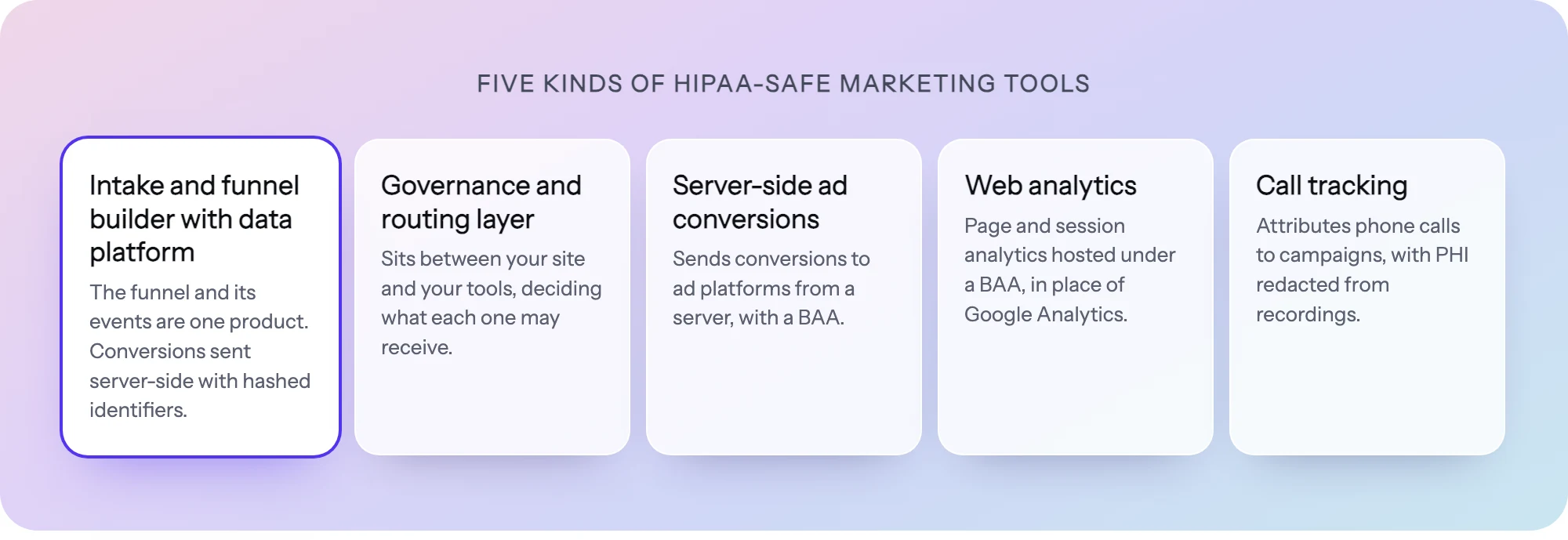
PathwAI is an AI-native builder for patient intake flows, with a built-in Data Platform for conversion tracking, attribution and ad audiences. Conversions go server-side to Meta (Conversions API), Google Ads (Enhanced Conversions and Customer Match), TikTok (Events API) and Microsoft Ads (offline conversions). Email and phone are SHA-256 hashed and PHI such as date of birth and condition is stripped before any event leaves, and ad platforms only receive data for visitors who consented. There are no third-party pixels: the script loads from your own domain with first-party cookies. Conversions are attributed to the ad, campaign and keyword using click ids (gclid, fbclid, msclkid) and UTMs captured on the visit. Because the funnel is built in the same product, the conversion is the real step (eligible, paid), not a thank-you page view.
Limitation: no call tracking, and not a BI pipeline. The BAA is on the Enterprise plan only, and PathwAI is not SOC 2 certified at this time.
Pricing: scoped per customer, no public list price. The Data Platform is priced by monthly tracked users, with unlimited events.
Data governance and routing layer
These tools sit between your website and every other tool. They collect events server-side under a BAA and decide what each destination receives.
Freshpaint. Best for: healthcare marketing teams that want to replace pixels across a large site and keep their other tools. Freshpaint describes itself as a healthcare privacy platform and says it signs a BAA. It controls which tools receive data and what is shared, including blocking data sent to destinations that are not compliant, and it has a consent manager that applies consent rules by state. Limitation: it governs data you collect elsewhere, so your forms and booking tools still need their own setup and their own BAAs, and the plan that carries the BAA is not stated publicly. Pricing: three plans (Comply, Perform, Scale), no published prices.
Ours Privacy. Best for: smaller teams that want a BAA without negotiating up to enterprise. Ours Privacy is a HIPAA-focused CDP with server-side tag management. Its Essential plan (up to 50,000 monthly tracked users) includes its standard BAA; Core and above can get a custom one. Limitation: Essential covers Google Ads, Meta, GA4 and one more destination, and the consent manager is an add-on. Pricing: tiered by monthly tracked users; no dollar prices published.
Tealium. Best for: large organizations that already run an enterprise tag and data stack. Tealium is a customer data platform and tag manager. It says it signs a BAA with its Private Cloud customers, and only for accounts using its HIPAA-eligible Private Cloud services. Limitation: the BAA is tied to Private Cloud, a dedicated environment that is more platform than a small telehealth brand needs. Pricing: quote.
Server-side ad conversions
Curve. Best for: practices and telehealth brands whose site and forms work and who only need ad conversions sent safely. Curve (Curve Compliance) sends server-side conversions to Meta, Google Ads, TikTok, Microsoft Ads and LinkedIn. It says every plan includes a BAA at no extra cost, and lists SOC 2 Type II. Limitation: the entry Compliance plan has no campaign reporting, forms or API access. Pricing: three usage-based plans, price given on a call.
For how this works step by step, see server-side conversion tracking for healthcare.
Web analytics
Piwik PRO. Best for: organizations replacing Google Analytics with analytics, tag management and data activation under one BAA. Its Healthcare Enterprise plan includes a BAA covering all three modules. Limitation: the standard Enterprise plan (from $25,000 a year) does not include the BAA, so check which plan a quote is for. Pricing: Healthcare Enterprise starts at $30,000 a year.
Matomo On-Premise. Best for: teams with engineers who already run HIPAA-ready hosting. Matomo says On-Premise can be configured for HIPAA on servers you own or lease from a HIPAA-compliant host, and that no BAA with Matomo is needed because it never hosts or accesses your data. Matomo Cloud, it says, is not HIPAA compliant. Limitation: the security work (a BAA with your host, encryption at rest, secure connections) is yours, and it is an analytics tool, not an ad conversion tool. Pricing: the Community edition is free; hosting is not.
Call tracking
CallRail. Best for: practices where most patients call before they book. Its Healthcare plan includes a BAA and covers call attribution, recording, transcripts and call scoring. Limitation: the BAA comes only with the Healthcare plan, not the standard plans from $50 a month. Pricing: Healthcare plans start at $150 a month.
Invoca. Best for: health systems and large groups handling high call volumes. Invoca says it signs a BAA with covered entities, attributes calls to channel, ad and keyword, and uses AI to redact PHI from recordings and transcripts. Limitation: its pricing page does not say which tier carries the BAA. Pricing: quote.
Liine. Best for: multisite healthcare and dental groups that want calls, web leads and online bookings tied to appointments. Liine matches marketing data to more than 60 EHR and practice management systems and says every package includes a BAA. Limitation: it is built around practices with phones and front desks; an async telehealth brand gets less from it. Pricing: custom quote.
Marketing data pipeline
Improvado. Best for: teams that report ad spend against CRM and EHR outcomes in a warehouse or BI tool. Improvado lists more than 1,400 integrations, signs a BAA, and lists HIPAA on its Growth and Enterprise plans. Limitation: it moves data other tools collect; it does not replace pixels on your site. Its Starter plan (from $20,000 a year) excludes HIPAA. Pricing: Growth from $50,000 a year; Enterprise by quote.
How to choose by your gap
| Your gap | Category to look at | Tools above |
|---|---|---|
| Pixels on your site or intake send health data to ad platforms | Data governance layer, or server-side conversions | Freshpaint, Ours Privacy, Tealium, Curve, PathwAI |
| Ad platforms do not know who became a patient | Server-side conversions tied to the real outcome | PathwAI, Curve, Freshpaint |
| You cannot see where people drop out of the funnel | Funnel and step analytics | PathwAI (flows built in it), Piwik PRO, Matomo |
| Most conversions happen by phone | Call tracking | CallRail, Invoca, Liine |
| Leadership wants spend, patients and revenue in one report | Data pipeline into a warehouse | Improvado |
Two common mistakes. Buying an analytics suite to fix a pixel problem: Piwik PRO will report on your site, but your Meta pixel still fires until you remove it. And routing the wrong event safely: if your “conversion” is a thank-you page view, a governance layer does not make it the right signal. Our guide to connecting ad clicks to patient intakes covers choosing the event.
How to set up attribution in PathwAI
- Build the flow in the visual builder: eligibility, intake, consent and checkout, with routing for ineligible answers. Your clinicians set the criteria.
- Add the consent step. It is timestamped and stored with the intake; ad platforms only receive events for visitors who consented.
- Connect Meta, Google Ads, TikTok and Microsoft Ads in the Data Platform. Identifiers are hashed and PHI is stripped before anything leaves.
- Pick the events: eligible, intake completed, paid. Click ids and UTMs from the visit tie each one to the ad, campaign and keyword.
- Sync audiences built from completions, drop-offs and consent status to Meta, Google and TikTok.
- Watch the steps. Step-level analytics show where people leave, and A/B tests compare a change against a control.
The BAA is on the Enterprise plan. If you are still choosing the intake tool itself, see the best patient intake software for 2026.
Checklist before you sign
- The vendor signs a BAA on the exact plan in your quote.
- PHI is removed on your side or a BAA-covered vendor’s side before any ad platform sees it.
- Browser ad pixels are removed from intake, booking and checkout pages, not just paused.
- Identifiers sent to ad platforms are hashed, and only for people who consented.
- Your conversion event is a real outcome (eligible, booked, paid), not a page view.
- Every downstream tool that receives PHI (CRM, email, call tracking, warehouse) has its own BAA.
- Counsel has reviewed any marketing use of PHI, including whether a written HIPAA authorization is required.
Frequently asked questions
Is Google Analytics HIPAA compliant?
Google’s help center says Google makes no representations that Google Analytics satisfies HIPAA requirements and does not offer BAAs for it. Since HHS expects a BAA with a tracking vendor that receives PHI, most healthcare teams keep it off pages with PHI, or send it only de-identified data through a BAA-covered layer.
Is server-side tracking automatically HIPAA compliant?
No. It moves the decision about what to send from the browser to a server. It is only safe if that server is covered by a BAA and strips PHI before the ad platform receives anything.
Do I need a BAA with Meta or Google?
The usual setup avoids sending them PHI at all: a vendor that signs your BAA removes PHI and passes on only hashed identifiers and allowed fields. That is what the governance and server-side tools above do. Ask your counsel how your setup meets HIPAA’s de-identification standard.
Do I still need ad-tracking consent if my vendor signs a BAA?
Yes, treat them as separate questions. The BAA covers your relationship with the vendor. Consent decides whether a visitor’s data goes to ad platforms at all. Ask your counsel what your states and your use of the data require.
PathwAI publishes this guide and is one of the tools listed. Details for other vendors come from their own websites as of October 2026 and can change; confirm them with each vendor before you sign.