
10 best patient intake software solutions for healthcare in 2026
The best patient intake software for 2026, compared by practice type: telehealth and DTC brands, health systems, small practices and behavioral health, with HIPAA and BAA notes.
Written for practice managers, operations leads and founders choosing an intake tool
The best patient intake software depends on where your patients start. If they start online, from an ad or your website, as in telehealth and direct-to-consumer health, you need intake that converts and tracks where patients came from: PathwAI is built for that. If they start at a front desk, in a clinic or health system, you need check-in, eligibility and payments: Phreesia leads there. Small practices and therapists are usually best served by IntakeQ or SimplePractice.
Below are ten tools compared side by side, what each is best for, and what to check before you sign.
Quick picks
| Tool | Best for | Kind of tool | Published pricing |
|---|---|---|---|
| PathwAI | Telehealth and DTC health brands | Online intake and funnel builder with ad attribution | Quote |
| Phreesia | Health systems and large practices | In-clinic and pre-visit intake, check-in, payments | Quote |
| Jotform (HIPAA) | Simple HIPAA forms on a budget | General form builder with HIPAA plans | Yes |
| Formsort | Product teams that want deep control | Flexible form and flow builder | Quote |
| IntakeQ | Solo and small practices | Intake forms plus practice management | From $29.90/month |
| SimplePractice | Therapists and behavioral health | Practice management with client intake | From $49/month |
| Luma Health | Health systems on Epic, MEDITECH or NextGen | Patient access and intake by text | Quote |
| CERTIFY Health | Specialty and multi-location practices | Intake, scheduling and payments | Yes |
| OhMD | Independent practices that live on text | Text-first intake and messaging | Yes |
| Promptly | Specialty practices with heavy pre-visit billing | Registration plus financial clearance | Quote |
Pricing as listed on each vendor’s site in October 2026. “Quote” means no public price.
What is patient intake software?
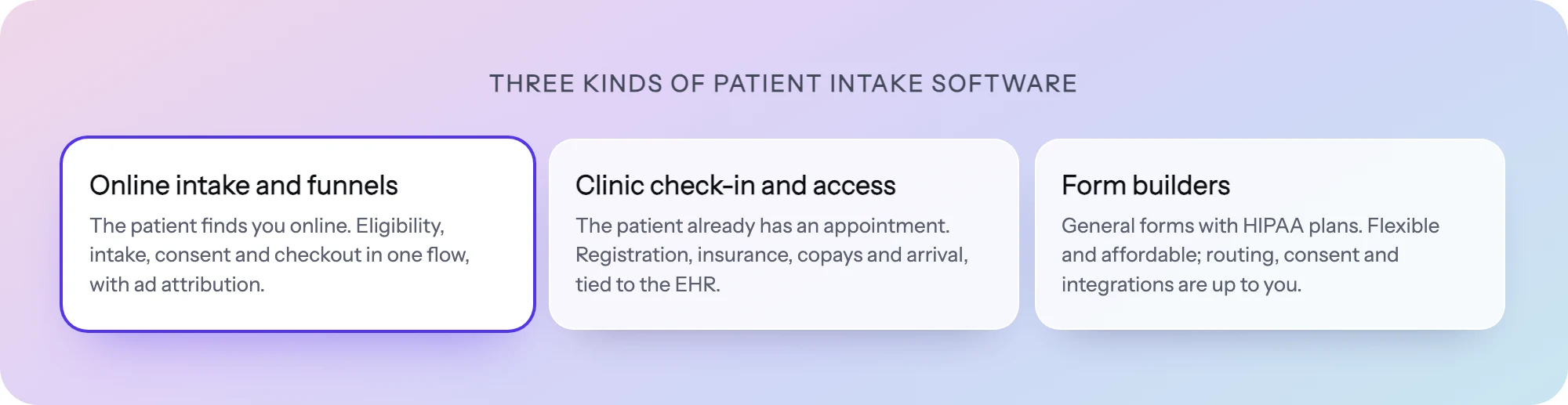
Patient intake software collects what a provider needs before a visit (demographics, medical history, insurance, consent and often payment) digitally instead of on a clipboard, and passes it to the systems the care team uses. It comes in three kinds that are easy to confuse:
- Online intake and funnels. The patient finds you online and the intake is how they become a patient: eligibility questions, intake, consent and checkout in one guided flow. Conversion and ad attribution matter as much as the form.
- Clinic check-in and patient access. The patient already has an appointment. The software handles registration, insurance eligibility, copays and arrival, usually tightly tied to an EHR.
- Form builders. General tools for building forms, some with HIPAA plans. Flexible and affordable, but routing, consent records and integrations are up to you.
Most buying mistakes come from choosing a tool from the wrong kind.
How we compared them
We looked at each tool against the same five questions:
- Fit: which kind of practice it is built for.
- HIPAA: whether the vendor signs a Business Associate Agreement, and on which plan.
- Integrations: where the answers go (EHR, CRM, billing).
- Patient experience: whether a patient can finish on a phone without help.
- Pricing: whether it is published.
Facts about each product come from the vendor’s own website. A disclosure: PathwAI is our product. We have kept its entry to what it actually does, and said what it is not built for.
The 10 best patient intake software solutions
1. PathwAI
Best for: telehealth and direct-to-consumer health brands that acquire patients online, such as GLP-1, HRT, men’s and women’s health, dermatology and aesthetics programs.
PathwAI is an AI-native builder for patient intake flows: eligibility quiz, medical intake, consent and checkout on one visual canvas, with routing on any answer so people who do not qualify get their own ending. Consent is its own step, timestamped and stored with the answers. Its AI agent drafts a whole flow from a description of your program for your team to review, without patient data in the prompt.
What sets it apart from the rest of this list is the built-in Data Platform: conversions go to Meta, Google, TikTok and Microsoft from the server, with identifiers hashed, health answers stripped and nothing sent without consent. That lets you see which ads bring paying patients without putting a pixel on your intake. Step-level analytics and A/B tests show where patients stop.
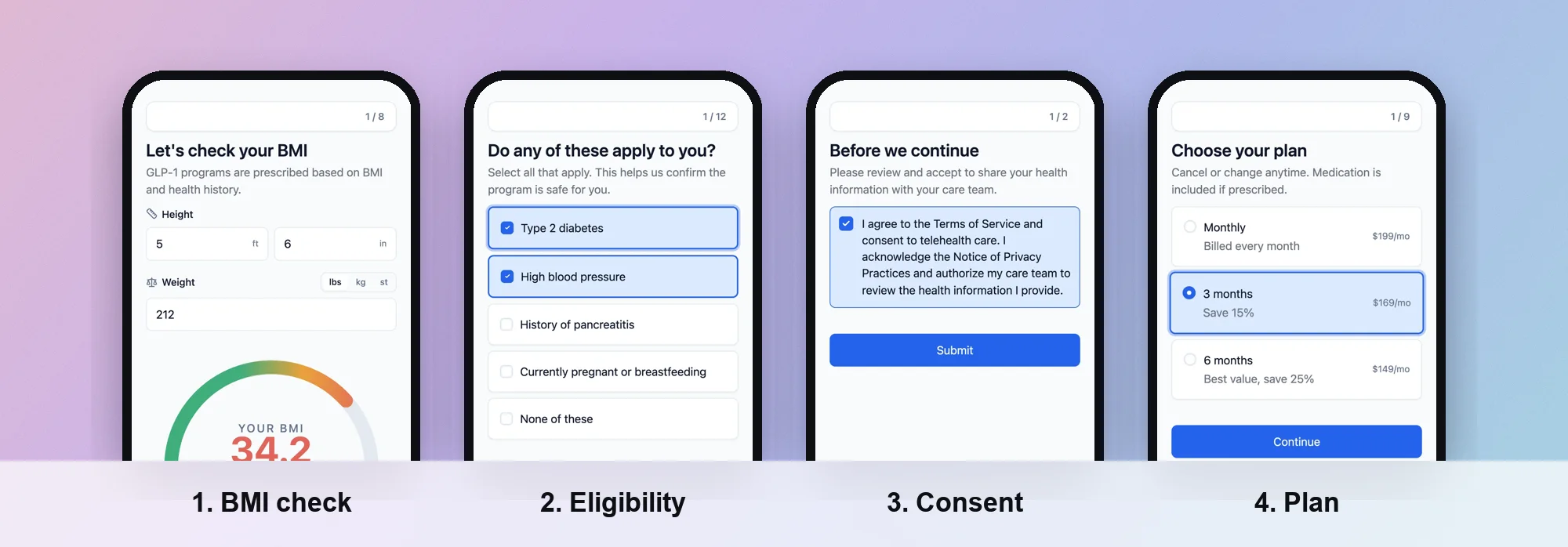 A GLP-1 flow built in PathwAI: BMI check, eligibility, consent, plan.
Worth knowing: PathwAI is not an EHR and does not do in-clinic check-in or insurance eligibility. It signs a BAA on its Enterprise plan and is not SOC 2 certified at this time.
Pricing: scoped to volume and integrations, see pricing.
2. Phreesia
Best for: health systems, hospitals and large multi-specialty practices.
Phreesia is one of the longest-standing names in patient intake, with more than 20 years in the category. It handles scheduling, registration, benefit verification, copay collection and payments around the visit, on the patient’s phone before arrival or on its own tablets and kiosks in the clinic, and it integrates with the major EHRs. Phreesia says it is involved in about one in six US patient visits.
Worth knowing: it is built around the clinic visit and the front desk, so it is more than a cash-pay telehealth brand needs, and setup is a project.
Pricing: quote only.
3. Jotform (HIPAA)
Best for: small teams that need HIPAA-compliant forms quickly and cheaply.
Jotform is a general form builder with a large template library. On its Gold and Enterprise plans it offers HIPAA features, and covered entities that enable them get a signed BAA.
Worth knowing: a form builder leaves the workflow to you. Eligibility routing, consent records, payment and delivery to your EHR need configuration or other tools, and there is no patient-acquisition tracking.
Pricing: published; HIPAA requires the Gold plan or above.
4. Formsort
Best for: product and engineering teams at health companies that want detailed control over a flow.
Formsort is a flexible form and flow builder used by health and finance companies. It offers a standard BAA and says it is SOC 2 certified. It pairs a no-code editor with webhooks and developer documentation, so teams with engineers can wire it deeply into their stack.
Worth knowing: the flexibility tends to pay off most with technical help on hand, and ad attribution is not part of the product.
Pricing: quote only.
5. IntakeQ
Best for: solo practitioners and small practices, including cash-pay and wellness clinics.
IntakeQ combines customizable online intake forms and e-signatures with scheduling, billing and telehealth in its Practice Management plan. It offers a 14-day free trial.
Worth knowing: its pricing page lists the HIPAA BAA on the Forms Only plan, not on the low-volume plans, so confirm which plan includes it before collecting PHI.
Pricing: from $29.90 a month (low-volume Forms Only) to $84.90 a month (Practice Management).
6. SimplePractice
Best for: therapists, counselors and behavioral health group practices.
SimplePractice is practice management software for behavioral health with intake built in: clients complete intake questionnaires, sign consents and book through a client portal, alongside reminders, telehealth and billing. It offers a signed BAA.
Worth knowing: it is a full practice system, not an intake layer for another EHR, and it is focused on behavioral health.
Pricing: Starter $49, Essential $79 and Plus $99 a month for solo practices, with a free trial; group pricing varies.
7. Luma Health
Best for: health systems and specialty networks running Epic, MEDITECH, NextGen and similar EHRs.
Luma Health sends patients one checklist by text covering intake, forms, consents and payment, runs eligibility checks before the visit, and collects copays and balances by text. It integrates with athenahealth, eClinicalWorks, Epic, Oracle Health and MEDITECH, and is built into NextGen Healthcare, Nextech, Greenway Health and PCC.
Worth knowing: its scope (patient access across the whole system) is more than a single practice usually needs.
Pricing: quote only.
8. CERTIFY Health
Best for: specialty and multi-location practices where intake and payment errors cost claims.
CERTIFY Health runs intake forms and eConsents, scheduling, insurance eligibility and payments in one system, with kiosk and biometric check-in options in the clinic.
Worth knowing: like the other clinic platforms, it is designed around in-person visits.
Pricing: published on its site, with intake and the scheduling and payment modules priced separately.
9. OhMD
Best for: independent practices that want intake, messaging and phone calls handled by text.
OhMD sends intake forms to the patient’s phone by text link, with no portal login, and routes submissions into the chart. It also handles two-way texting and automated responses for routine requests, and says it integrates with a long list of EHR and practice management systems.
Worth knowing: it is a communication tool first, so complex eligibility logic is not its strength.
Pricing: published on its site.
10. Promptly
Best for: specialty practices such as ophthalmology, dermatology and orthopedics where billing has to be cleared before the visit.
Promptly sends patients a secure link by text or email to complete registration, reads insurance and ID cards, and combines clinical registration with financial clearance, writing the results back to the practice management system.
Worth knowing: its value is in the pre-visit billing workflow; a practice without insurance complexity will not use most of it.
Pricing: quote only.
Which one fits your practice?
- Telehealth or DTC brand acquiring patients online: PathwAI. Formsort if you have engineers and want to build more yourself.
- Health system or hospital: Phreesia or Luma Health.
- Specialty or multi-location practice: CERTIFY Health or Promptly.
- Solo or small practice: IntakeQ, or OhMD if your patients prefer text.
- Therapist or behavioral health group: SimplePractice.
- Simple HIPAA forms, small budget: Jotform on a HIPAA plan.
What to check before you buy
- The BAA, on your plan. Many vendors only sign a Business Associate Agreement on higher tiers. Get it signed before any patient data goes in.
- Where the answers go. Ask to see a submission arrive in your EHR or CRM, structured, not as a PDF.
- Trackers on intake pages. If you advertise, make sure no ad pixel runs on the pages where patients enter health information. The HHS guidance on online tracking explains why.
- Consent records. Confirm consent is captured as its own step and stored with the answers.
- Drop-off by step. You should be able to see where patients stop, not only how many finish.
- The phone experience. Complete the intake yourself on a phone before you sign.
Our HIPAA-ready intake playbook covers each of these in more detail.
Frequently asked questions
What is the best patient intake software for telehealth?
For telehealth and direct-to-consumer programs that acquire patients online, look for intake that runs as a guided flow on a phone, routes people by eligibility, records consent and connects ad spend to completed intakes without exposing health data. PathwAI is built for that. Clinic-focused tools such as Phreesia or Luma Health are stronger when patients already have an appointment.
Is Jotform HIPAA compliant?
Jotform offers HIPAA features on its Gold and Enterprise plans, and covered entities that enable them receive a signed BAA. Lower plans are not set up for PHI.
Do I need a BAA with my intake software vendor?
If you are a HIPAA covered entity and the tool collects or stores protected health information for you, yes. Check which plan includes the BAA before you collect real patient data.
How much does patient intake software cost?
Small-practice tools publish prices: IntakeQ from $29.90 a month and SimplePractice from $49 a month as of October 2026. Platforms for health systems and growth-focused telehealth brands, including Phreesia, Luma Health and PathwAI, price by quote based on volume and integrations.
PathwAI publishes this guide and is one of the tools listed. Product details for other vendors come from their websites as of October 2026 and can change; confirm them with each vendor.