
How to build an ED telehealth intake flow with eligibility screening
The step order for an online ED intake: goal question, symptoms, a safety screen built from the FDA labels, discreet copy, plan reveal and async review.
Written for operators and growth leads at men's health and sexual health telehealth brands
An ED telehealth intake flow should open with the patient’s goal, move through symptoms and timeline, then run a safety screen for nitrates, guanylate cyclase stimulators, alpha-blockers and cardiac history before any treatment is shown. After that comes the plan reveal, consent, checkout and an asynchronous review by a licensed clinician. The safety screen is the part that cannot be skipped, and its questions come straight from the FDA prescribing information for the PDE5 inhibitors. Your clinicians decide what makes a patient eligible; the flow collects what they need in an order patients will finish.
What is an ED telehealth intake flow?
It is the online path from an ad or your website to a prescriber’s review for erectile dysfunction treatment. Instead of a long static form, it asks one question per screen, branches on the answers, and hands a complete record to the clinician.
ED has two features that shape the flow more than in most categories:
- The subject is sensitive. Patients hesitate to type answers about sexual function into a website. Wording and pacing decide whether they finish.
- The main contraindication is a medication interaction that can be dangerous. The flow has to surface nitrate use and cardiac history reliably, and route those patients away from a prescription path before they see a price.
For the wider patterns behind these flows, see how Hims, Ro and Hers build intake flows.
The step structure
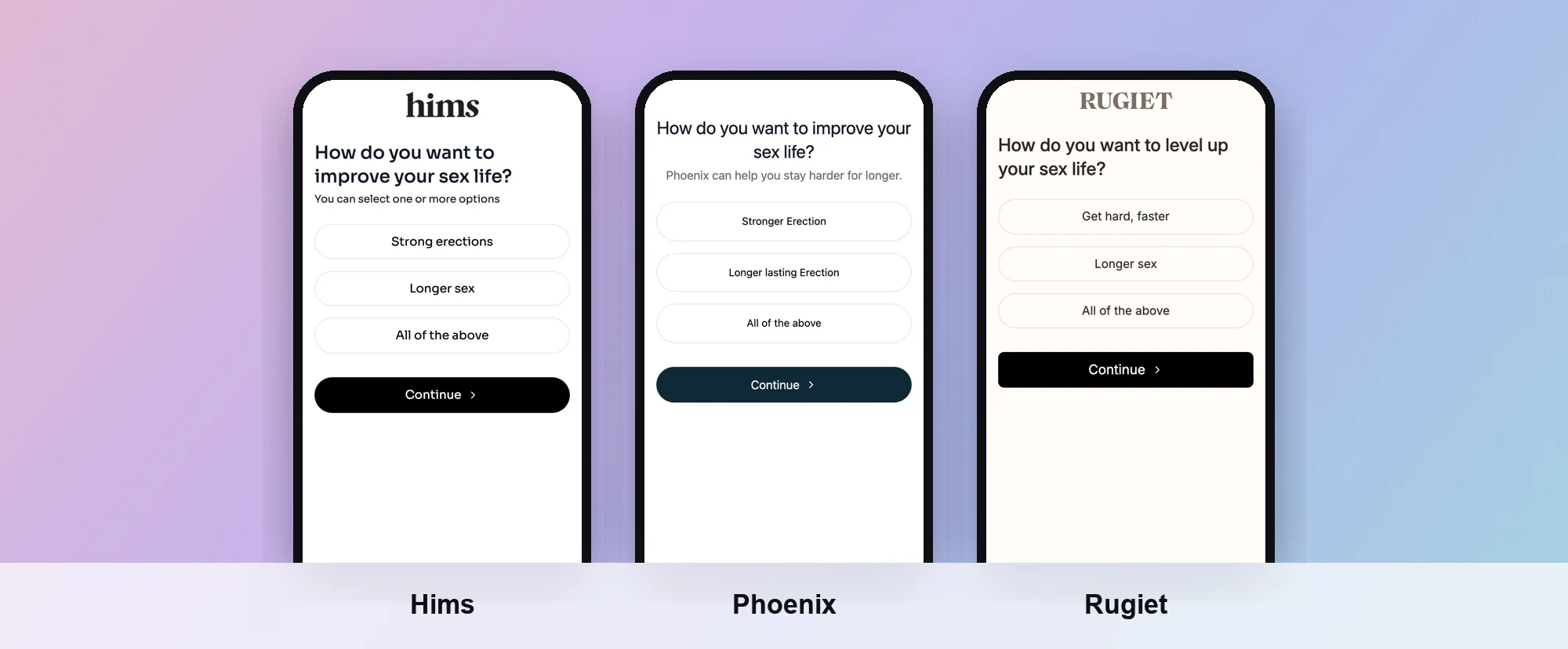 Screens from PathwAI’s rebuilds of the public flows; brand names belong to their owners.
PathwAI rebuilt the public ED flows of Hims, Phoenix and Rugiet as working replicas. In our rebuilds, Hims runs 8 steps, Phoenix 9 and Rugiet 10. Brands change their flows often, so treat those counts as a snapshot. All three open the same way: a single goal question about improving sex life, with two or three short answers and a Continue button. None of them opens with a medical question.
Across the three, the order settles into this shape:
| Step | What it asks | Why it sits here |
|---|---|---|
| 1. Goal | What the patient wants to improve | Easy to answer, frames the visit around an outcome |
| 2. Symptoms and timeline | How often, since when, situational or constant | Gives the clinician context on onset and frequency |
| 3. Safety screen | Nitrates, other medications, cardiac and blood pressure history | Must come before any treatment or price is shown |
| 4. Health and lifestyle | Other conditions, alcohol, smoking, prior ED treatment | Fills in the record the prescriber reviews |
| 5. Education and plan reveal | How the options work, the recommended plan | Shown only to patients who passed the screen |
| 6. Consent and account | Telehealth consent, contact details | Collected once the patient has a reason to commit |
| 7. Checkout | Payment, shipping | Held until a clinician approves, or charged on approval |
| 8. Async clinician review | Prescriber reviews, messages if needed | Happens after the patient leaves the flow |
1. Goal
Hims and Phoenix both ask “How do you want to improve your sex life?” Rugiet asks how the patient wants to “level up” theirs. The answers are about outcomes (stronger erections, longer sex, all of the above), not symptoms. It frames the visit around results, not a diagnosis. Hims lets the patient pick more than one option.
2. Symptoms and timeline
Next, ask how often the problem happens and how long it has been going on. Phoenix uses timeline questions to separate situational from ongoing ED, and grades severity so the prescriber has context for the dose conversation.
3. Safety screen
This is the core of an ED flow, covered in detail in the next section. Rugiet asks about nitrates and alpha-blockers early, and Phoenix runs its cardiovascular screening before any treatment option is shown. Both choices are correct: a patient should never see a plan they cannot be prescribed.
4. Health and lifestyle
Other conditions, alcohol use, smoking, and whether the patient has tried ED medication before. Prior use matters to the prescriber.
5. Education and plan reveal
Hims shows visual comparison cards for treatment options, so patients understand them before committing. Rugiet positions its compounded formulas against single-ingredient products. Whatever your catalog, the pattern is the same: explain, then recommend, then let the patient choose.
6 to 8. Consent, checkout and review
Consent and account creation come after the plan reveal, when the patient has seen what they are signing up for. Checkout follows. Then a licensed clinician reviews the intake asynchronously and either approves, asks a follow-up question or declines. If you run this model, the async consult pattern covers how the handoff works.
The safety screen: what the FDA labels say
The questions in your safety screen should map to the contraindications and warnings in the FDA prescribing information for the drugs you offer. Your clinicians write the final criteria, but the labels give you the list to start from.
The VIAGRA (sildenafil) label lists three contraindications: use with nitric oxide donors “such as organic nitrates or organic nitrites in any form”, known hypersensitivity to sildenafil, and use with guanylate cyclase (GC) stimulators such as riociguat. The CIALIS (tadalafil) label lists the same three categories: organic nitrates in any form, serious hypersensitivity to tadalafil, and GC stimulators such as riociguat. Both labels note they may not be the latest version, so have your clinical team check current labeling.
Beyond the hard contraindications, the labels carry warnings your screen should capture:
- Cardiovascular status. Both labels say patients should not use the drug if sexual activity is inadvisable because of their cardiovascular status.
- Recent cardiac events. The sildenafil label says there are no controlled clinical data in patients who had a heart attack, stroke or life-threatening arrhythmia within the last 6 months, or who have resting blood pressure below 90/50 or above 170/110 mmHg. The tadalafil label says it is not recommended for patients with a heart attack in the last 90 days, unstable angina or angina during intercourse, heart failure (NYHA Class 2 or greater) in the last 6 months, uncontrolled arrhythmias, hypotension, uncontrolled hypertension, or a stroke in the last 6 months.
- Alpha-blockers. These are a caution, not a contraindication. The sildenafil label advises caution with alpha-blockers and recommends starting at 25 mg with them. The tadalafil label advises caution when used for ED in men taking alpha-blockers. Your clinicians need to know about them, so ask.
- Alcohol. The tadalafil label warns that substantial alcohol (5 units or more) with the drug may lead to hypotension.
- Eye and hearing history. Both labels tell patients to stop and seek care for sudden vision loss (a possible sign of NAION) or sudden hearing loss, and to use caution in patients with a history of NAION.
- Priapism. Both labels tell patients to seek emergency treatment for an erection lasting more than 4 hours.
The sildenafil patient information also names street drugs called “poppers” (amyl or butyl nitrite) alongside prescription nitrates. Patients do not always think of poppers as a medication, so name them explicitly in the question.
Turning the labels into questions
A screen that patients answer accurately uses plain language and examples:
- “Do you take any nitrate medicine for chest pain, such as nitroglycerin? This includes sprays, patches and tablets.”
- “Do you use poppers (amyl or butyl nitrite)?”
- “Do you take riociguat (Adempas) or another medicine for pulmonary hypertension?”
- “Do you take a medicine for prostate or blood pressure, such as tamsulosin or doxazosin?”
- “In the last 6 months, have you had a heart attack, stroke, heart surgery or an irregular heartbeat that needed treatment?”
- “Has a doctor told you to avoid sexual activity because of your heart?”
Routing on the answers
Decide with your clinicians what each answer does. A common setup:
| Answer | Route |
|---|---|
| Nitrates, poppers or a GC stimulator | Stop the prescription path; show a message explaining why and suggesting they speak with their doctor |
| Recent cardiac event or advice to avoid sex | Stop, or route to a live consult if your clinicians offer one |
| Alpha-blocker, blood pressure medicine | Continue, flagged for the prescriber |
| None of the above | Continue to health and lifestyle |
The stop screen matters. A patient who is turned away should understand why, in plain words, and leave with a next step.
Discreet language that keeps patients moving
Phoenix’s flow uses discreet, judgment-free wording on sensitive questions, and Hims writes in a conversational tone with short motivational copy between question groups. A few rules hold across all three:
- Lead with outcomes, then symptoms. The goal question earns the right to ask the harder ones.
- Explain why you ask. One line under a sensitive question (“Your provider needs this to prescribe safely”) makes the question feel clinical, not nosy.
- Use the patient’s words. “Stronger erections” reads better than “erectile rigidity.”
- One question per screen. On a phone, a single short question is easier to answer honestly than a long form.
- Keep page titles and email subjects discreet. It matters to patients who share a phone or laptop.
For the psychology behind this, see patient psychology in intake flows.
Build it in PathwAI
PathwAI is an AI-native patient acquisition platform. You describe the program in plain English and its agent drafts the flow: steps, patient-facing copy and routing. Your team reviews and edits the draft, and nothing publishes without explicit approval.
A prompt for an ED program might read: “ED intake for a men’s health brand. Open with a goal question. Ask symptom frequency and duration. Screen for nitrates, poppers, riociguat, alpha-blockers and cardiac events in the last 6 months. Stop the prescription path on nitrates or a GC stimulator with a clear explanation. Then health and lifestyle, a plan reveal for sildenafil and tadalafil, consent and checkout.”
Then, on the visual canvas:
- Check the safety screen against your clinicians’ criteria. Routing rules branch on any answer or combination of answers, so a nitrate answer can end the path while an alpha-blocker answer continues with a flag.
- Write the stop screens. Ineligible patients get a custom message, a waitlist or another treatment path.
- Add consent as its own step. Patients must acknowledge before continuing, and the consent is timestamped and stored with the intake. Have your clinical or legal team review the wording.
- Connect checkout and review. Steps can take payments through Stripe or Authorize.Net, and the intake can go to your EHR or care platform through integrations such as Healthie, CarePortals or webhooks.
- Publish on your own domain as a hosted link or an embed, and share a preview link with your clinical team first.
- Watch step-level drop-off. Analytics show completion and drop-off for every screen, and you can A/B test copy, step order or routing against a control.
No patient data is used in the generation prompts. A BAA is available on the Enterprise plan.
Checklist
- Goal question first, no medical questions on screen one
- Symptoms and timeline before the safety screen
- Safety screen built from the current FDA labels for every drug you offer, approved by your clinicians
- Poppers and riociguat named explicitly, not only “nitrates”
- Clear stop screens with a next step for patients who cannot continue
- Alpha-blockers and blood pressure medicines flagged for the prescriber, not silently passed
- Plan reveal only after the screen
- Consent as its own step, reviewed by clinical or legal
- Discreet page titles and email subjects
- Step-level drop-off tracked from launch
Frequently asked questions
What should an ED intake screen for before showing treatment?
At minimum, the contraindications in the FDA labels for sildenafil and tadalafil: organic nitrates or nitrites in any form, hypersensitivity, and guanylate cyclase stimulators such as riociguat. Most programs also screen cardiac history, blood pressure, alpha-blockers and alcohol. Your clinicians set the final criteria.
Are alpha-blockers a reason to decline a patient?
Not on the labels. Both list alpha-blockers as a caution rather than a contraindication. Ask about them and pass the answer to the prescriber, who decides on dose or suitability.
Where should the safety questions go in the flow?
After the goal and symptom questions, and before any plan or price. A patient should never see a treatment they cannot be prescribed.
Should checkout come before or after clinician review?
Either can work. One common setup collects payment details in the flow and charges or ships only after a clinician approves. Choose with your clinical and finance teams, and say clearly on the checkout screen what happens if the prescriber declines.
Can an ED intake flow run on my own domain?
With PathwAI, yes. Flows run on your own domain or embedded on your website, and the Data Platform sends conversions server-side with hashed identifiers, only for visitors who consented.