
How Hims, Ro and Hers build their intake flows (and what to copy)
A teardown of 13 telehealth intake flows, from Hims, Ro and Hers to Alloy and Hone Health: the patterns they share, what to improve and how to build your own.
Written for growth and product leads at telehealth and DTC health brands designing an intake flow
Hims, Ro and Hers build intake flows that feel like a short conversation, not a medical form. Across the 13 flows we studied, the same six moves repeat: ask about the patient’s goal before their history, use plain and judgment-free language, screen for safety early, put education or reassurance between question groups, replace jargon with pictures and cards, and end on a clear recommendation or plan instead of a “thanks, we’ll be in touch” page.
What an intake flow is for a DTC telehealth brand
For a direct-to-consumer telehealth brand, the intake flow is the product’s front door. It is the screens a visitor completes after clicking an ad or a “Get started” button: goals, medical screening, contact details, often consent and payment, then a hand-off to a clinician.
It does three jobs at once:
- Clinical: it collects what a licensed provider needs to decide whether a treatment is appropriate, by criteria the brand’s clinicians set.
- Commercial: it turns a visitor into a patient who has paid or booked.
- Operational: it routes people. Eligible patients go on to checkout; others see a different treatment, a waitlist or an honest “this isn’t right for you” message.
A clinic intake form only has to do the first job. A DTC flow has to do all three, which is why the best ones look nothing like a clipboard.
How we studied these flows
PathwAI rebuilt the public intake flows of 13 telehealth brands as working replicas: Hims (ED), Ro (hair loss), Hers (weight loss), WW, Found, Happy Heads, Phoenix, Rugiet, Alloy, Pandia Health, Evernow, Eden and Hone Health. Everything below comes from what any visitor can see on the public sites. We have no access to any brand’s internal data or conversion rates. Brands change their flows often, so treat step counts as a snapshot. All brand names are trademarks of their respective owners, and none of these brands is affiliated with or endorses PathwAI.
The patterns, one by one
1. Goal first, history second
The most common opening move is to ask what the patient wants before asking what is wrong with them.
- Hims and Happy Heads ask what the patient wants to achieve before any medical history.
- WW lets people name their weight loss motivation before the clinical questions start.
- Rugiet opens with performance goals, and Hone Health opens with a vitality hook that frames hormone therapy around how the patient wants to feel.
- Alloy and Eden open with symptoms (“what are you dealing with?”), and Evernow and Pandia Health ask what kind of support or visit the patient is looking for.
Why it works: the first question is easy, positive and about the patient. It also gives the brand an answer to personalize the rest of the flow: “more energy” and “better sleep” can lead to different copy and recommendations.
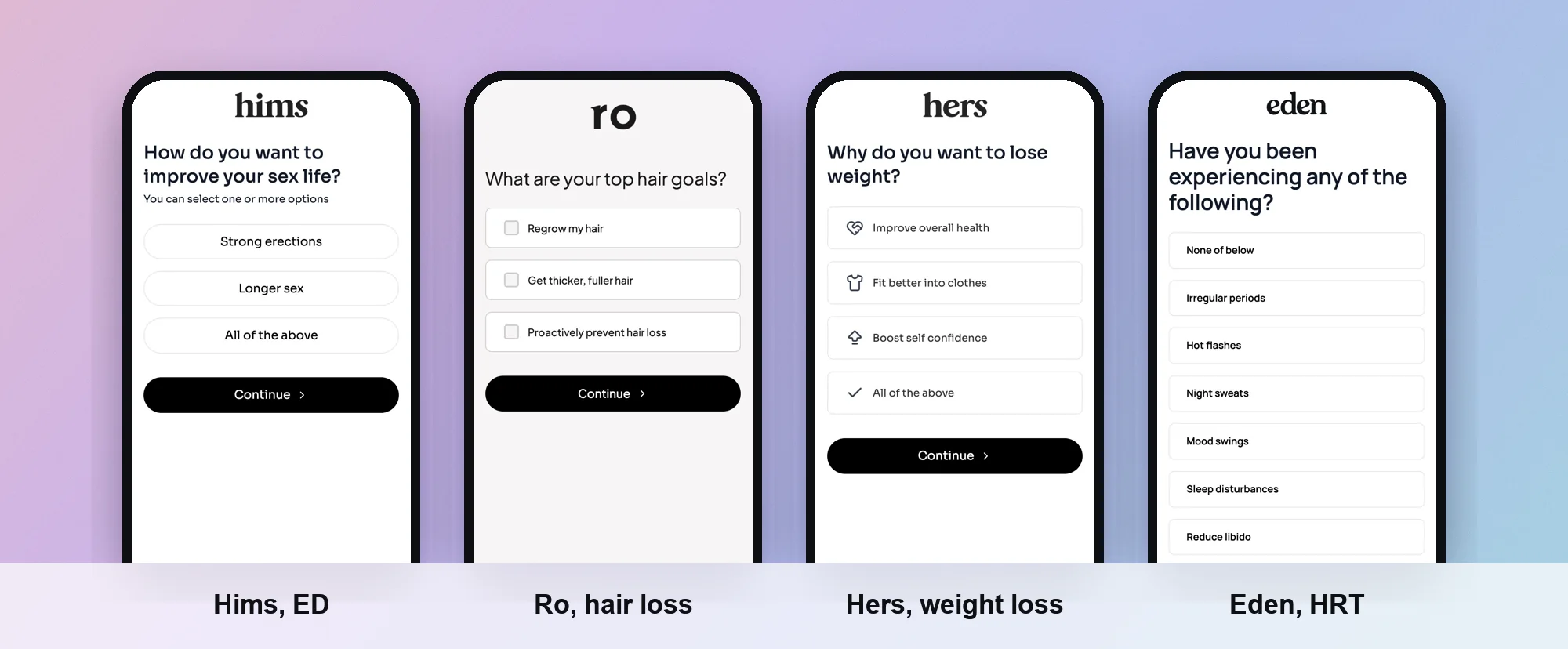 Every one of these flows opens with a goal question, not a medical one. Screens from PathwAI’s rebuilds of the public flows; brand names and logos belong to their owners.
2. Plain, judgment-free language
ED, weight and menopause are subjects people are reluctant to type into a website. The best flows write like a calm clinician.
- Phoenix uses discreet, judgment-free wording on sensitive ED questions.
- Found keeps a judgment-free tone about weight throughout.
- Hers uses first-person answers (“I want to…”) so a clinical question reads like something the patient would say.
- Alloy and Pandia Health treat menopause, sex at birth and ethnicity questions with inclusive, neutral wording.
Why it works: a person who feels judged on screen four does not reach screen ten. Tone is a conversion decision as much as a brand one. More in our guide to patient psychology in intake flows.
3. Safety screening early, not at the end
The better flows find out early whether a treatment could be unsafe, so nobody is walked to a checkout they cannot use.
- Rugiet asks about medications such as nitrates and alpha-blockers early in its ED flow.
- Phoenix screens lifestyle and cardiovascular history before showing treatment options.
- Eden layers its medical screening and flags contraindications early, while “safe-answer” paths keep eligible patients moving.
- WW and Found use BMI and medical history to decide which program or medication path is shown.
- Ro asks about family history and how long hair loss has progressed, which helps a provider judge which treatment fits.
Why it works: an ineligible patient who learns that on screen three is disappointed; one who learns it after entering a card number is angry. Which answers disqualify, and what to show instead, are clinical decisions for the brand’s medical team.
4. Education and reassurance between question groups
- Found explains how GLP-1 medications work before asking the eligibility questions, and groups its screening into named phases (history, lifestyle, medications).
- Hims and Hers place short motivational copy between question groups.
- WW and Rugiet place social proof and success stories between sections, and WW shows a personalized weight projection mid-flow.
- Hone Health uses interstitial copy about testosterone decline to explain why the questions matter.
Why it works: a break screen resets attention and answers the question patients are silently asking (“why do they need this?”). Keep any claims on those screens accurate and reviewed: an educational screen in a health flow is still health marketing.
5. Pictures and cards instead of jargon
- Ro uses a visual hair loss pattern selector so patients can find their stage without medical terms, and includes a photo upload so the clinician sees what the patient sees.
- Hims and Hers use visual treatment comparison cards so patients understand their options before they commit.
- Eden keeps many sensitive questions to a simple yes or no, which lowers effort.
Why it works: most patients do not know the clinical name for what they have. A picture removes the guessing, and a yes/no question takes one tap.
6. End on a plan, a price or a booking
The strongest flows end on a next step, not a generic confirmation.
- WW recommends a program tier based on the patient’s answers.
- Happy Heads and Rugiet position the result as a personalized formula.
- Hone Health ends at a checkout that bundles testing, consultation and treatment plan, so the price arrives with what it pays for.
- Evernow checks insurance mid-flow, so cost is clear before the commitment step, and ends with calendar booking.
Why it works: a result that reflects the patient’s answers makes their effort feel worth it, and puts the purchase or booking where intent is highest.
A note on contact capture and consent
Pandia Health captures email before the longer intake, so a lead is saved even if the patient stops halfway (see the FAQ for the trade-off). Our replicas did not record consent placement in detail, so we describe no brand’s choice. The general rule: put each consent where it applies (telehealth consent before the clinical questions, subscription terms at checkout), require an active acknowledgment and store the timestamp with the intake. Our HIPAA intake playbook goes deeper.
The 13 flows at a glance
Step counts are the screens in our replica of each public flow, at the time we studied it.
| Brand | Condition | Steps | Notable move |
|---|---|---|---|
| Hims | ED | 8 | Goal-first opening and visual treatment comparison cards |
| Ro | Hair loss | 9 | Visual hair loss pattern selector plus a photo upload for the clinician |
| Hers | Weight loss | 7 | First-person answers written for women’s weight loss concerns |
| WW | Weight loss | 10 | Personalized weight projection mid-flow, tiered program recommendation |
| Found | Weight loss | 12 | Screening grouped into phases, GLP-1 education before eligibility |
| Happy Heads | Hair loss | 10 | Personalized formula positioning with visible progress |
| Phoenix | ED | 9 | Cardiovascular screening before any treatment is shown |
| Rugiet | ED | 10 | Early screening for nitrates and alpha-blockers |
| Alloy | Menopause | 10 | Symptom-first opening, hormonal stage captured early |
| Pandia Health | Menopause | 13 | Email captured first; patient chooses the visit goal |
| Evernow | Menopause | 15 | Insurance check mid-flow and calendar booking at the end |
| Eden | HRT | 17 | Symptom checklist plus layered yes/no screening |
| Hone Health | HRT | 10 | Vitality hook and a bundled checkout |
The spread runs from 7 screens (Hers) to 17 (Eden). Length tracks clinical need more than brand style: hormone therapy needs more history than a hair loss quiz, so the longest flows lean hardest on phases and yes/no questions.
What they get wrong, or what you can improve
While rebuilding these flows we noted improvements. Some brands may already do them in versions we did not see, so read these as ideas to test.
- Skip what does not apply. Found, Phoenix, Alloy, Ro and Eden could branch more on earlier answers, for example routing hair loss patients to topical or oral paths by severity.
- Save progress. Found, Hers, Hims, Happy Heads and Rugiet could let a patient pause to find a medication name, or switch devices, and resume.
- Explain terms in place. Hers, Happy Heads and Rugiet could explain words like GLP-1, BMI, DHT or “compounded” with an inline tooltip in place.
- Route by location. Pandia Health and Evernow could use state or zip code to send patients to providers licensed or available where they live.
- Show a summary before the ask. Eden could play back the selected symptoms and next steps, and Hone Health could show a result screen before checkout.
- Show how far is left. On longer flows like Eden’s, a clear progress indicator matters more, and Hone Health’s existing progress bar could be more prominent.
- Measure each screen. Almost every flow would benefit from step-level drop-off data and A/B tests on copy and order. Otherwise you are guessing which screen is the problem.
One more gap is invisible from the outside: tracking. If you run ads, the ad platforms want conversion data, and health answers must not go with it. In July 2023 the FTC and HHS jointly warned about 130 hospital systems and telehealth providers about tracking technologies such as the Meta pixel and Google Analytics disclosing health information. HHS has published guidance on online tracking technologies for organizations covered by HIPAA. Copying the screens without a safe way to measure them is half the job.
How to build a flow like this in PathwAI
PathwAI is an AI-native builder for intake flows, eligibility quizzes and checkout funnels. Each pattern above maps to something you can set up without engineering:
- Start from a template or a prompt. Use one of the templates, such as GLP-1 eligibility and intake, or describe your program in plain English and the AI agent drafts steps, copy and routing. Your team reviews the draft; nothing publishes without approval, and consent wording goes to your clinical or legal team.
- Lay out the screens on the canvas. In the visual builder, put the goal question first, group screening into phases and add education screens between them. Fields include yes/no, multiple choice, file upload (for a photo like Ro’s), BMI calculators, medication lists and screening instruments.
- Route on answers. Branch on any answer or combination of answers. Eligible patients continue to intake and checkout; ineligible patients get a custom message, a waitlist or another treatment path. Your clinicians set the criteria.
- Make consent its own step. Patients acknowledge before continuing, and the consent is timestamped and stored with the intake.
- End on the plan. Take payment with Stripe or Authorize.Net, book with Cal.com, or verify ID with Persona, all inside the flow.
- Measure and test. Step-level analytics and A/B testing show completion and drop-off for every screen, and let you test copy, step order or routing against a control.
- Track conversions without leaking health data. The Data Platform sends conversions server-side to Meta, Google, TikTok and Microsoft, with email and phone SHA-256 hashed, PHI such as date of birth and condition stripped, and only for visitors who consented.
Flows run on your own domain or embedded on your website. A BAA is available on the Enterprise plan.
Checklist: what to copy
- The first question is about the patient’s goal or main symptom, not their history.
- Copy is plain, calm and judgment-free, especially on sensitive questions.
- Safety questions come early, with criteria set by your clinicians, and ineligible patients get a next step.
- Long screenings are split into phases, with pictures or yes/no where they help.
- Each consent sits where it applies, with an active acknowledgment.
- The flow ends on a recommendation, price or booking that reflects the answers.
- You can see drop-off for every screen and run A/B tests.
- Ad conversions are sent without health answers, and only with consent.
Frequently asked questions
How many steps should a telehealth intake flow have?
As many as your clinicians need, and no more. In our study the range was 7 to 17 screens. Cut any question a clinician will not use, branch past what does not apply, and watch where patients drop off.
Should I ask for an email at the start or the end?
Earlier capture saves more leads you can follow up with; later capture asks less of a patient who has not seen value yet. Pandia Health asks first. A middle ground is right after the goal questions. Test it with your own traffic.
Can I copy a competitor’s intake questions?
Copy the structure, not the clinical content. Eligibility questions and disqualifying answers must come from your own clinicians and match your treatments, and your copy and brand should be your own.
Where should the price appear in an intake flow?
Usually right after a recommendation that reflects the patient’s answers, bundled with what it pays for, as in Hone Health’s checkout. If cost is a common objection, set expectations earlier, as Evernow does with its mid-flow insurance check.