
How to build a hair loss telehealth quiz funnel
Build a hair loss quiz funnel: lessons from the Ro and Happy Head flows, the step order, the finasteride and minoxidil questions clinicians set, and consent.
Written for operators and growth leads at men's health, women's health and hair loss telehealth brands
A hair loss telehealth quiz funnel works best in this order: the patient’s goal, their hair loss history and pattern, photos of the scalp, the medication and safety questions your clinicians require, consent, and then a plan with a price. The two public flows we studied, Ro and Happy Head, both open with something easy and personal and keep the medical questions for later. The safety questions themselves come from the drug labels and your prescribers, not from the marketing team.
This guide walks through that structure screen by screen, shows what the FDA labels for finasteride and minoxidil mean for the questions you ask, and ends with how to build the funnel in PathwAI.
What is a hair loss quiz funnel?
It is the online path from an ad or a landing page to a prescriber’s review of a hair loss patient. It looks like a quiz (one question per screen, quick taps, a result at the end) but it does the work of an intake form: it collects what a clinician needs to decide whether finasteride, minoxidil or something else is appropriate, and it ends in checkout or a consult.
The quiz framing matters because hair loss is an elective, self-conscious purchase: most visitors are curious, a bit embarrassed and comparing options. A funnel that starts with a long medical history loses them before they have said what they want. A funnel that never asks the safety questions puts the brand and the prescriber at risk. The structure below is how the better flows balance the two.
How we studied the Ro and Happy Head flows
PathwAI keeps rebuilds of public telehealth flows in its library, made by going through each brand’s live funnel and recreating the screens. Our Ro rebuild has 9 steps and our Happy Head rebuild has 10. We look at the order of questions, the answer options and the copy, not at anything behind a login. For the wider set of 13 flows, including Hims and Hers, see how Hims, Ro and Hers build their intake flows.
What the two hair loss flows open with:
| Screen | Ro | Happy Head |
|---|---|---|
| 1 | ”What are your top hair goals?” (regrow, thicker hair, prevent loss; multi-select) | “What was your sex assigned at birth?“ |
| 2 | ”What hair loss solutions have you tried, if any?” (non-prescription, prescription, none) | “How long have you been experiencing hair loss?” (under 6 months, 6 months to 2 years, over 2 years) |
| 3 | ”What’s the main reason you haven’t tried hair loss treatment before?” (not sure it works, cost, side effects, didn’t need to) | “Where on your head are you experiencing hair loss?” (hairline, bald patches, crown, other, prevention; with illustrations) |
| 4 | Email capture, framed around the result the patient wants | ”How committed are you to hair growth?” (exploring, committed, want results fast) |
Two different philosophies show up in four screens. Ro leads with motivation and objections: it learns what the patient wants and what has stopped them so far, then asks for an email while interest is high. Happy Head leads with routing data: sex at birth decides which treatments are even on the table, and duration and pattern feed the clinical picture straight away. Both then move into medical history.
The step structure
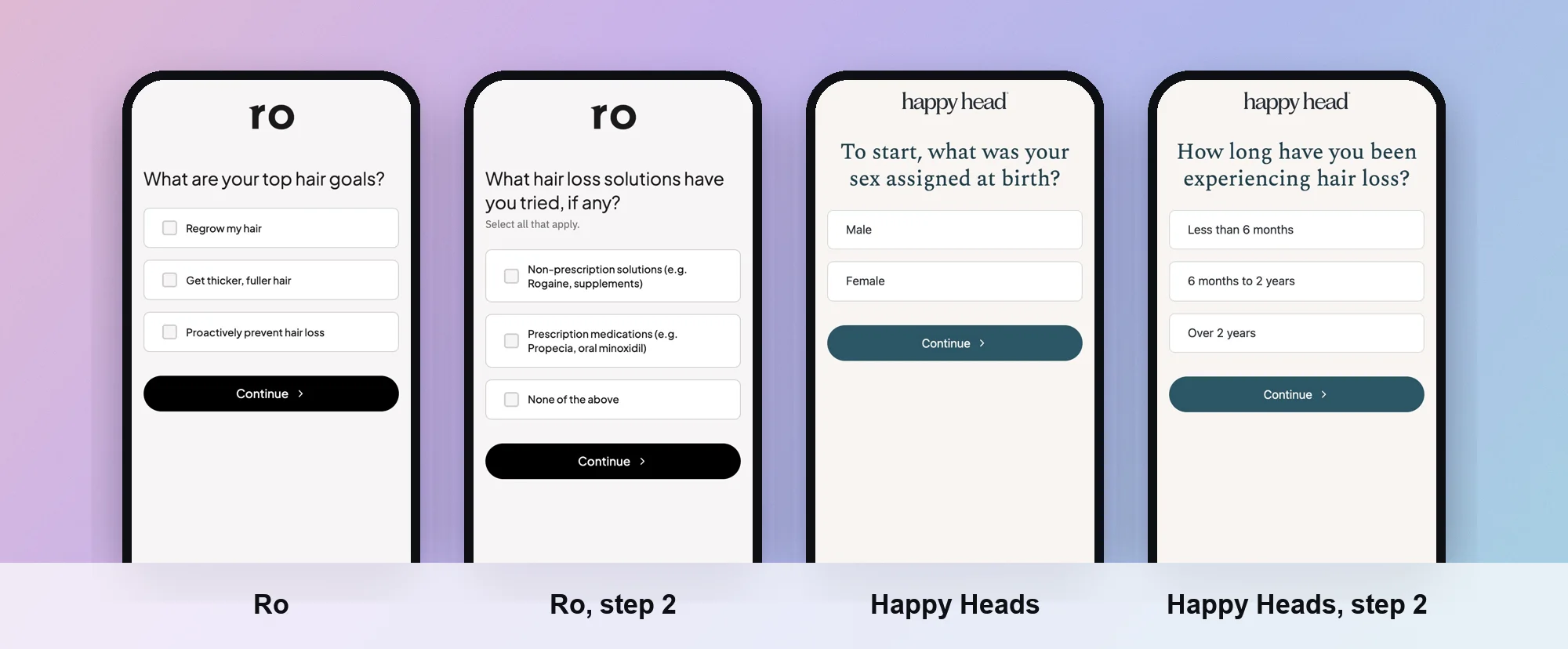 Screens from PathwAI’s rebuilds of the public flows; brand names belong to their owners.
Here is the structure we recommend, combining what works in both flows.
1. Goal
Open with one easy question about what the patient wants: regrow, thicken, or prevent. It costs nothing to answer and lets you tailor later copy (“to help you keep your hairline”); the reasoning is in patient psychology in intake flows. Ro’s multi-select works well here because many people want more than one outcome.
2. Hair goals and past attempts
Ask what they have tried. Ro’s split into non-prescription products, prescription medication, or nothing is useful twice: it tells the clinician about prior exposure, and it tells you which objection to answer. Someone who used an over-the-counter product and stopped needs a different message from someone who has never tried anything. Follow with the reason they have not treated it yet, and answer that reason on the next screen with a short, factual note.
3. Hair loss history and pattern
This is where Happy Head is stronger. Ask:
- Sex assigned at birth, early, because it changes which treatments a prescriber can consider (see the finasteride label below).
- How long the loss has been happening.
- Where it is happening, with simple illustrations instead of clinical scale names.
- Whether it was sudden or patchy, and whether there is a family history.
The last two are not decoration. The 2% minoxidil topical label tells consumers not to use it if their hair loss is sudden or patchy, if they have no family history of hair loss, or if they do not know the reason for their hair loss. A patient who answers “sudden” or “patchy” should be routed to a clinician conversation or a different path, not straight to a minoxidil plan. Your clinicians decide where that branch goes.
4. Photos
Ask for photos of the hairline, the crown and the top of the head, with a sample image showing the angle you want. Photos give the prescriber visual context for a remote review and help confirm the pattern the patient described. Put this step after the patient has invested a few answers, explain who will see the photos, and allow a retake.
5. Medical history and contraindications
This block is set by your clinicians. The labels give you a starting point for the questions they will want (details in the next section): pregnancy and the possibility of pregnancy, heart disease, current medications applied to the scalp, prior prostate issues and PSA testing, and mood history. Keep it to one question per screen and use yes or no wherever you can, with a follow-up only when the answer is yes.
6. Consent
Consent should be its own step, not a checkbox buried under the price. It typically covers telehealth consent, acknowledgment of the treatment’s known risks as written by your clinical team, and your privacy terms. Wording must be reviewed by your clinical or legal team.
7. Plan and checkout
End on a recommendation and a price. If a clinician has to approve the prescription, say so plainly (“a licensed provider will review your answers”). The label for finasteride notes that, in general, daily use for three months or more is necessary before benefit is observed, so the plan page is the right place to set expectations about time, not to promise results.
The finasteride and minoxidil questions clinicians set
The marketing team writes the copy. The questions that decide eligibility come from the prescribers, and the FDA labels are what most of them will start from. Here is what each label says that touches a quiz funnel. This is not clinical guidance; it is a map of where your clinicians will likely want a question.
| Label statement | Source | Question it usually turns into |
|---|---|---|
| Finasteride 1 mg is indicated for male pattern hair loss in men only, and is not indicated for women or pediatric patients | PROPECIA prescribing information | Sex assigned at birth and age, early in the flow, routing women and minors away from oral finasteride |
| Contraindicated in pregnancy; women who are or may be pregnant should not handle crushed or broken tablets | PROPECIA prescribing information, sections 4 and 5.1 | Whether anyone in the home who could become pregnant may handle the tablets (often an education screen rather than a question) |
| Finasteride lowers serum PSA, and a confirmed rise while on it should be evaluated | PROPECIA prescribing information, section 5.2 | Prior prostate conditions and whether the patient has PSA testing |
| Postmarketing reports include depression and suicidal ideation and behavior; common adverse reactions include decreased libido, erectile dysfunction and ejaculation disorder | PROPECIA prescribing information, sections 6.1 and 6.2 | History of depression or other mental health conditions, current sexual health concerns |
| Topical 2% minoxidil: do not use if loss is sudden or patchy, there is no family history, the cause is unknown, or the user is under 18; ask a doctor first if you have heart disease | 2% minoxidil topical solution label | Onset and pattern, family history, age, heart disease |
| Topical 2% minoxidil: may be harmful if used when pregnant or breast-feeding | 2% minoxidil topical solution label | Pregnancy and breastfeeding, for women on the topical path |
| Oral minoxidil (LONITEN) carries a boxed warning about pericardial effusion and angina, and the label states that using it to promote hair growth is not an approved indication | LONITEN tablets label | If your prescribers offer oral minoxidil at all, a cardiac history block they write and review |
Three practical rules follow from that table:
- Route early on the questions that remove whole treatment options. Sex at birth and age decide whether finasteride is even possible. Asking them first, as Happy Head does, avoids showing a woman a plan she cannot have.
- Do not soften the safety questions into marketing copy. “Any heart issues?” is friendlier than “Do you have a history of cardiovascular disease?”, but your clinicians must sign off that the friendly version still captures what they need.
- Show the label’s caveats where they apply. A short screen that explains the PSA effect or the handling warning, placed right before the related question, reads as care rather than fine print.
How to build it in PathwAI
PathwAI is an AI-native patient acquisition platform: an agent drafts the flow from a plain-English description and your team reviews and approves it. For a hair loss funnel:
- Describe the program to the agent. For example: “Hair loss quiz for men and women. Start with goals, then past treatments, then sex at birth, age, duration, pattern with illustrations, family history, photos, a medical history block our clinicians will write, consent, and a plan with Stripe checkout. Route women away from finasteride.” The agent generates the steps, the patient-facing copy and the routing as a draft. Nothing publishes without your approval, and no patient data is used in the prompt.
- Refine on the canvas. In the visual builder, eligibility, intake, consent and checkout steps sit on one canvas. Routing rules branch on any answer or combination, so “sudden or patchy” can send a patient to a clinician message while everyone else continues. Ineligible patients get a custom message, a waitlist or another treatment path. The same patterns power our eligibility quiz setups.
- Add the photo step. File upload is a built-in field type. If you want an automated first look, the AI Scan step can analyze a photo with Claude, GPT or Gemini on your own key, as an aid for your clinicians.
- Make consent a real step. Patients must acknowledge before continuing, and the consent is timestamped and stored with the intake data. Have your clinical or legal team review the wording.
- Take payment or book a consult. Steps can take payments through Stripe or Authorize.Net and book appointments through Cal.com. Send the intake to your EHR or CRM through integrations such as Healthie, HubSpot or webhooks.
- Track what the ads bring in. The Data Platform sends conversions server-side to Meta, Google Ads, TikTok and Microsoft Ads, with email and phone SHA-256 hashed, PHI such as condition stripped, and only for visitors who consented.
- Watch each step and test. Step-level completion and drop-off show where people leave (often the photo step or the medical block). You can A/B test step order, for example Ro’s goal-first opening against Happy Head’s sex-at-birth opening, against a control.
Flows run on your own domain or embedded on your website, and most teams ship a working first draft within a day or two of their demo call.
Checklist
- First screen is one easy question (goal or a single demographic tap)
- Sex at birth and age asked before any finasteride plan is shown
- Onset, pattern and family history asked, with “sudden or patchy” routed to a clinician path
- Photo step with sample angles, a note on who sees them, and a retake option
- Medical history block written and approved by your prescribers, based on the current labels
- Label caveats (PSA, handling, pregnancy, heart disease) explained where the related question appears
- Consent as its own step, wording reviewed by clinical or legal
- Plan page sets time expectations without promising results
- Server-side, consent-gated conversion tracking in place before ad spend scales
- Step-level drop-off reviewed weekly, one A/B test running at a time
Frequently asked questions
Should a hair loss quiz ask medical questions first or last?
Neither extreme. Start with a goal or one easy question, ask the routing questions that remove whole treatments (sex at birth, age) early, and put the detailed medical history after the patient has invested a few answers and uploaded photos. Both Ro and Happy Head keep the heavy medical block out of the first screens.
Can women go through the same hair loss funnel as men?
Yes, with routing. The finasteride 1 mg label says it is indicated for men only and is not indicated for women, so women need a separate path, often built around topical minoxidil or whatever your prescribers offer. One flow with a branch after the sex-at-birth question is usually easier to maintain than two flows.
Do we need photos for a hair loss telehealth consult?
That is a clinical decision for your prescribers and depends on the rules where you operate. Most hair loss flows we have studied include a photo step because it gives the reviewing clinician visual context for a remote decision.
Who writes the safety questions in the quiz?
Your clinicians. The marketing or growth team can make the questions clearer and friendlier, but the prescribers decide what is asked, what disqualifies a patient and where an ineligible patient goes. The FDA labels for finasteride and minoxidil are the usual starting point.
What software should we use to build a hair loss quiz funnel?
Look for routing on any answer, a photo upload step, consent stored with the intake, built-in checkout, step-level analytics and server-side conversion tracking. PathwAI covers those in one platform, with an agent that drafts the first version for your team to review.