
How WW, Found and Hers build weight loss quiz funnels
A teardown of the WW, Found and Hers weight loss quiz funnels: goal framing, projected results, education, BMI, history and plan cards, plus what to test.
Written for growth and product leads at telehealth and DTC weight loss brands designing or fixing a quiz funnel
WW, Found and Hers build their weight loss quiz funnels the same basic way: they open with the patient’s goal, not their medical history, keep one question per screen, explain the treatment between groups of questions, work out BMI from height and weight, and end on a recommended plan instead of a form confirmation. Where they differ is in tone and in how much they promise along the way. WW leans on a projected results screen and social proof, Found leans on education and a calm, structured intake, and Hers leans on first-person, motivational copy and treatment cards.
What is a weight loss quiz funnel?
A weight loss quiz funnel is the sequence of screens a visitor completes after clicking an ad or a “Get started” button on a weight loss telehealth site. It usually has three parts:
- The quiz: goal, age, sex, height and weight. Short, personal, fast.
- The intake: medical history, medications, prior treatment and safety questions a clinician needs to review the case.
- The plan and checkout: a recommended program or medication, a price and a payment step.
The quiz is a filter and a hook at once; the intake is a clinical document. Our GLP-1 intake flow guide covers that split in detail.
How we looked at these flows
PathwAI rebuilt the public weight loss flows of WW, Found and Hers as working replicas, using only what any visitor can see on the brands’ public sites. We have no access to their internal data, conversion rates or test results. Brands change these flows often, so treat every step count here as a snapshot of our rebuild, not of the live site today. WW, Found and Hers are trademarks of their respective owners, and none of them is affiliated with or endorses PathwAI.
The three funnels at a glance
| WW | Found | Hers | |
|---|---|---|---|
| Steps in our rebuild | 10 | 12 | 7 |
| Shape | Quiz | Intake | Quiz |
| First question | ”What is your weight-loss goal?” (pounds to lose) | Date of birth, as age ranges | ”Why do you want to lose weight?” |
| Tone | Motivational, community | Calm, judgment-free, clinical | Warm, first person, women-focused |
| Mid-flow device | Projected weight screen, success stories | Educational screens on how GLP-1s work | Motivational copy between groups |
| History | Grouped, after the goal | Grouped into History, Lifestyle, Medications | Short GLP-1 screen |
| Ending | Tiered program recommendation | Treatment plan and provider matching | Treatment comparison cards |
Hers is the shortest; Found is the longest and the most like an intake. WW is the only one that recommends more than one kind of program from the same quiz.
The patterns
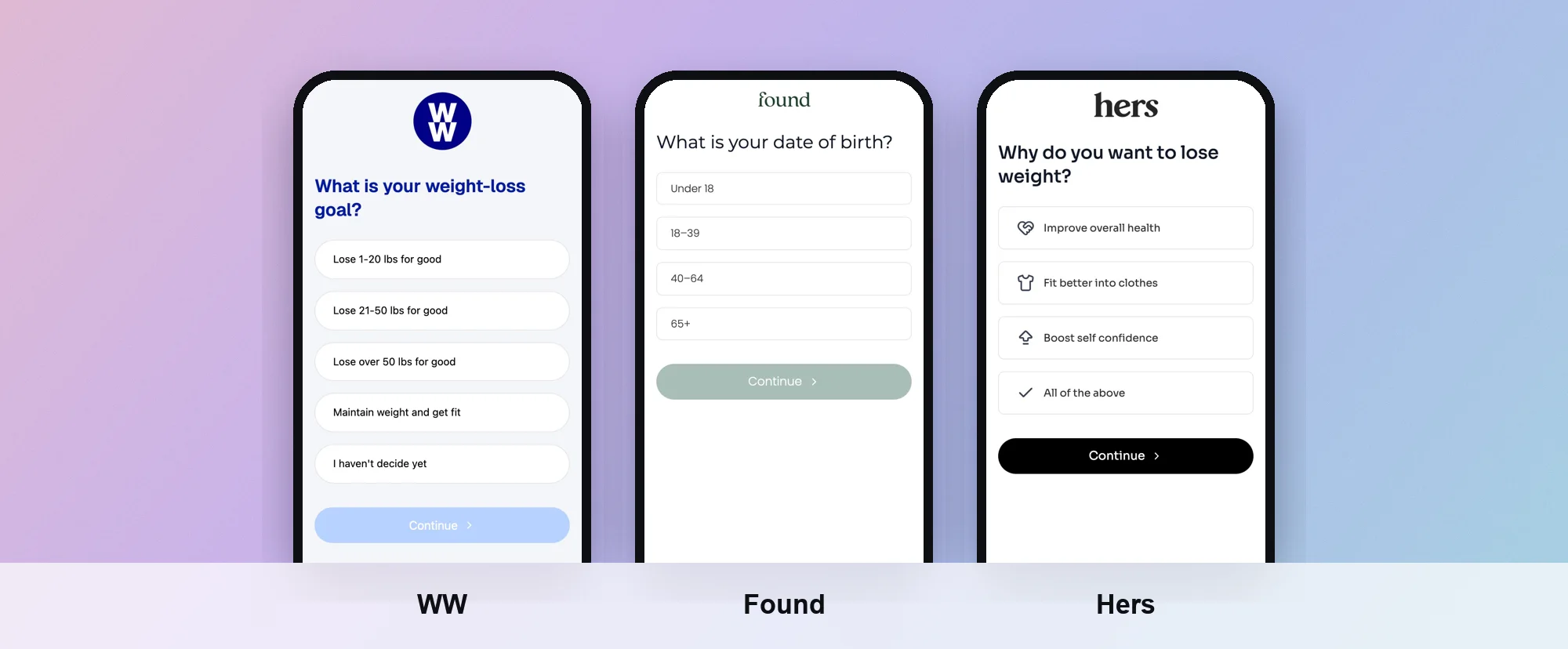 Screens from PathwAI’s rebuilds of the public flows; brand names belong to their owners.
1. Goal framing comes first
Two of the three open with a goal question.
- WW asks “What is your weight-loss goal?” with answers in pound ranges (“Lose 1-20 lbs for good”, “Lose 21-50 lbs for good”, “Lose over 50 lbs for good”), plus “Maintain weight and get fit” and an “I haven’t decided yet” option.
- Hers opens with “Why do you want to lose weight?” (improve overall health, fit better into clothes, boost self confidence, all of the above), then “Welcome, let’s get started. What’s your weight loss goal?” with ranges from 1-15 lbs to 101+ lbs and a “Not sure, I just need to lose weight” answer.
- Found is the exception. Its first screen asks for date of birth as age ranges (under 18, 18 to 39, 40 to 64, 65+), which screens out minors immediately.
What to copy: an easy first answer about what the person wants. Both WW and Hers give a “not sure” option, so nobody is stuck on screen one. The answer is also useful later: it can personalize copy (“Here is your plan to lose 21 to 50 lbs”) and feed the plan recommendation.
What to test: Found’s approach. If much of your paid traffic is outside your criteria, asking that first spares them a quiz that ends in “not eligible”. Test both orders on your own traffic.
2. One question per screen, with a disabled Continue
All three use one question per screen on mobile, large tap targets and a Continue button that stays greyed out until an answer is picked. It is a small detail that prevents empty submissions and makes each screen feel like one decision.
Sex assigned at birth gets its own screen in WW and Found. Found offers Male, Female and Intersex; WW offers Male and Female. That question matters clinically (pregnancy questions only apply to some patients), so it is usually what the next branch depends on.
3. Education between questions
This is where Found stands apart. It places educational screens that explain how GLP-1 medications work before it asks the eligibility questions, and it groups the medical intake into phases (History, Lifestyle, Medications) so the patient always knows which part they are in.
Hers does a lighter version: motivational copy between question groups that reinforces that asking for help is a positive step. WW embeds social proof and success stories between groups.
What to copy: a screen that answers what the patient is already wondering (“How does this work?”, “What happens next?”) right before the hardest questions.
4. Projected results screens
WW shows a personalized weight projection screen in the middle of the flow. It is a strong commitment point: the patient sees their own goal turned into a date or a curve, and then keeps going to get it.
It is also the pattern with the most risk. The FTC’s Health Products Compliance Guidance says that “testimonials that report results more dramatic than users can generally expect are likely to be deceptive”, and that a “Results not typical” disclaimer does not cure that. Projections and success stories in a quiz are advertising. If you build one:
- base the curve on what your clinicians and your evidence support, not on a best case,
- have your legal team review the screen and any testimonial next to it,
- say clearly that results depend on the treatment a clinician prescribes, if any.
5. BMI from height and weight
Every weight loss flow asks for height and weight, because BMI is part of most programs’ criteria. The CDC’s BMI page gives the formula as weight (pounds) / [height (in)]² × 703, or weight (kg) / [height (m)]², and calls BMI “a simple, reliable, and low-cost screening measure”, while adding that “BMI is just one measure of health.”
The better builds calculate BMI live as the patient types and show it as information, not a verdict. WW uses BMI together with medical history to decide which program to recommend. Where the line sits, and what happens to someone just below it, is a decision for your clinicians, not for the quiz.
6. Medical history in phases
Found asks about previous medications and diet history, which helps the provider personalize a plan and tells the brand whether the person has tried GLP-1s before. WW asks its history questions after the goal and lifestyle questions. Hers keeps a short GLP-1 screen.
What to copy: group history questions by topic, show the group name, and use follow-ups that appear only when they apply. A patient who answers “no” to prior weight loss medication should never see “Which one, and at what dose?“.
7. Plan cards at the end
None of the three ends on “Thanks, we’ll be in touch.”
- WW ends on a tiered recommendation (its Points program, a GLP-1 program, or a clinical program) chosen from BMI and medical history.
- Hers shows visual treatment comparison cards so the patient can see their options before committing.
- Found ends on a treatment plan and provider matching.
What to copy: an ending that names what the patient is getting, what it costs and what happens next. For people who do not qualify for medication, a non-medication plan (like WW’s lower tier) is a better ending than a dead end, if your business offers one.
What to copy and what to test
| Pattern | Who does it | Copy it? | What to test |
|---|---|---|---|
| Goal question first | WW, Hers | Yes, with a “not sure” option | Goal-first vs. age or state first |
| One question per screen | All three | Yes | Grouping two easy questions on one screen |
| Educational interstitials | Found | Yes, before the hardest questions | With vs. without, by step drop-off |
| Projected results screen | WW | Only with legal review | Projection vs. a plain “your plan” summary |
| Success stories mid-flow | WW | Carefully (FTC guidance) | Placement, or removing them |
| Live BMI | WW, Found, Hers | Yes | Showing the number vs. hiding it |
| Phased history | Found | Yes | Phase labels on vs. off |
| Plan or treatment cards | All three | Yes | One recommended plan vs. a choice of two or three |
A pattern working for a brand with WW’s or Hers’ ad budget does not prove it works for yours. Treat each row as a hypothesis, run it against a control, and look at where people actually leave. Our Hims, Ro and Hers teardown covers the same patterns across 13 brands and other conditions.
How to do it in PathwAI
PathwAI is an AI-native patient acquisition platform: an agent builds the flow from a plain-English description and your team approves it. For a weight loss quiz funnel like the ones above, that looks like this.
- Start from the template or a description. The GLP-1 eligibility and intake template covers screening, a progressive medical intake, consent and checkout. Or describe your program (“goal question, age and state screen, live BMI, GLP-1 education screen, history in three phases, two plan cards”) and the AI agent drafts the steps, copy and routing. The result is a draft; nothing publishes until your team approves it, and no patient data is used in the prompts.
- Build the routing on the canvas. In the visual builder, routing rules branch on any answer or combination of answers. Eligible patients continue to intake and checkout; ineligible patients get a custom message, a waitlist or another treatment path. Your clinicians set the criteria.
- Use the right fields. Multiple choice for goals, numeric for height and weight, a BMI calculator, medication lists and date fields for history.
- Add consent and checkout. Consent is its own step, timestamped and stored with the intake data; your clinical or legal team supplies the wording. Payment steps run through Stripe or Authorize.Net.
- Measure each screen and test. Step-level analytics show completion and drop-off for every screen, and A/B tests compare copy, step order or routing against a control.
- Track conversions without pixels. The Data Platform sends conversions server-side to Meta, Google Ads, TikTok and Microsoft Ads with SHA-256 hashed identifiers, only for visitors who consented, and strips PHI before any event leaves.
Flows run on your own domain or embedded on your site. More on the program side: weight loss and GLP-1 programs.
Checklist
- First screen is an easy goal or a hard eligibility stop, chosen on purpose
- One question per screen, Continue disabled until answered
- Hard stops set by your clinicians come before anything long, and before payment
- BMI calculated live and shown as information
- An education screen before the hardest questions
- History grouped into labelled phases with conditional follow-ups
- Any projection or testimonial reviewed by legal against FTC guidance
- A plan ending with price and next step, and a kind ending for people who do not qualify
- Drop-off measured per step, and each copied pattern tested against a control
Frequently asked questions
Is it legal to copy another brand’s quiz funnel?
Copying a structure (goal first, BMI, phased history, plan cards) is common practice. Copying a brand’s logos, design or written copy is not something to do; trademarks and copyright belong to their owners. Write your own questions and copy, and ask your lawyer if you are unsure.
How many steps should a weight loss quiz have?
There is no right number. In our rebuilds, Hers runs 7 steps, WW 10 and Found 12. What matters is that each step earns its place, which you can only see with step-level drop-off data.
Should the quiz show a projected weight loss screen?
It can be a strong commitment point, but it is a claim. The FTC says results more dramatic than people can generally expect are likely deceptive, even with a disclaimer. Base it on what your clinicians support and have legal review it, or test a plain plan summary instead.
Can PathwAI build a funnel like these for my brand?
Yes. Describe your program and the AI agent drafts the flow, or start from the GLP-1 template, then edit it on the canvas and publish once your team approves it. See pricing for how plans are scoped.