
How to build a GLP-1 eligibility quiz and intake flow that converts
A step-by-step GLP-1 intake structure: goal, live BMI, contraindication screen, history, consent and checkout, with routing, compounded drug copy and drop-off.
Written for growth and operations leads launching or fixing a GLP-1 weight-loss program
A GLP-1 eligibility quiz that converts asks for the goal first, calculates BMI live from height and weight, screens the contraindications your clinicians set before anything long is asked, and only then collects medical history, consent and payment. People who do not qualify get a clear ending instead of a dead end.
This is a guide to building the flow, not clinical advice. Your clinicians decide who is eligible; the quiz collects the answers they need and routes people by their rules.
What is a GLP-1 eligibility quiz?
A GLP-1 eligibility quiz is the first part of a weight-loss telehealth funnel. It asks a few questions (goal, height, weight, safety) and decides whether the person continues to the medical intake a clinician will review: history, medications, allergies, consent and checkout.
The two parts do different jobs. The quiz is a filter: quick, personal, and it stops people you cannot treat before they type their history. The intake is a clinical document: complete, structured and easy for a prescriber to read. Mixing them (thyroid history on screen two, eligibility checked after payment) makes both worse.
What the FDA labels say about eligibility (and why your clinicians still decide)
Two branded medicines approved for weight reduction are Wegovy (semaglutide) and Zepbound (tirzepatide). Their FDA prescribing information is the natural starting point for a program’s criteria.
- Who they are for. The Wegovy prescribing information (revised 08/2025) indicates it, with diet and exercise, for weight reduction in adults and children 12 and older with obesity, and in adults with overweight and at least one weight-related comorbid condition. The Zepbound prescribing information (revised 08/2026) uses the same adult wording for weight reduction. The weight-management trials in both labels enrolled adults with a BMI of 30 kg/m² or more, or 27 to under 30 with at least one weight-related condition such as hypertension, dyslipidemia or type 2 diabetes.
- Contraindications. Both labels carry a boxed warning about thyroid C-cell tumors and are contraindicated in people with a personal or family history of medullary thyroid carcinoma (MTC) or with Multiple Endocrine Neoplasia syndrome type 2 (MEN 2), and in people with a known hypersensitivity to the drug (Zepbound says “known serious hypersensitivity”).
- Other things the labels flag. Both list warnings for pancreatitis, gallbladder disease, severe gastrointestinal reactions (neither is recommended with severe gastroparesis), hypoglycemia with insulin or insulin secretagogues, diabetic retinopathy in people with type 2 diabetes, and pulmonary aspiration during anesthesia. Both say to stop the drug when pregnancy is recognized; Wegovy’s says to stop at least 2 months before a planned pregnancy, and Zepbound’s has advice for people on oral contraceptives.
Whether a history of pancreatitis is a hard stop or a “clinician reviews” flag is your clinicians’ call, not the form builder’s. Write each rule down with them before you build it.
For the calculation itself, the CDC’s BMI formulas are weight (lb) / height (in)² × 703, or weight (kg) / height (m)². The CDC calls BMI a screening measure, so show it as information, not a verdict.
The step-by-step structure
Here is the order that works, built from the weight-loss flows we studied from WW, Found and Hers and from the structure in our GLP-1 eligibility and intake template.
| Step | What to ask | Why |
|---|---|---|
| 1. Goal | How much weight they want to lose, and what matters most (energy, health markers, confidence) | An easy first click that frames the flow around their goal |
| 2. Height and weight | Height and current weight, with BMI calculated live on the screen | The core eligibility input, shown back to the person |
| 3. Eligibility screen | Age, state, sex at birth, pregnancy or plans to become pregnant, personal or family history of MTC or MEN 2, other hard stops your clinicians set | Stops people who cannot be treated before they share a full history |
| 4. Weight-related conditions | Conditions such as hypertension, type 2 diabetes, high cholesterol, sleep apnea | Needed when BMI is in the overweight range and your criteria require a comorbid condition |
| 5. Medical history | Pancreatitis, gallbladder disease, gastroparesis, kidney problems, diabetic retinopathy, upcoming surgery | Gives the prescriber what the labels flag, as structured answers |
| 6. Medications and prior treatment | Current medications (insulin, sulfonylureas, oral contraceptives), current or past GLP-1 use, allergies, prior weight-loss attempts | Safety, dosing and coadministration questions the prescriber will ask anyway |
| 7. Consent | Telehealth consent, terms, privacy notice, a separate marketing opt-in | A recorded acknowledgment before any treatment decision |
| 8. Plan and checkout | Plan or medication preference, shipping, payment | Converts while intent is highest |
| 9. What happens next | Who reviews the intake, when, and how they will contact the patient | Nobody thinks they already bought a prescription |
A few patterns from the flows we studied are worth copying:
- Goal first. WW lets people say why they are there before any clinical question, so the first click is easy and personal.
- A projection or result moment mid-flow. WW shows a personalized weight projection partway through, so the quiz gives something back before the longer questions. Have your clinical and legal team review any projection copy.
- Group the medical questions into named phases. Found groups screening into phases (History, Lifestyle, Medications), so a long intake feels like three short ones.
- Explain before you ask. Found adds short screens on how GLP-1 medicines work before the eligibility questions. Hers uses visual comparison cards so people understand the treatment options before choosing.
- Judgment-free, first-person copy. Hers frames answers in the first person (“I want to…”) and Found keeps the tone neutral. Weight is a sensitive topic.
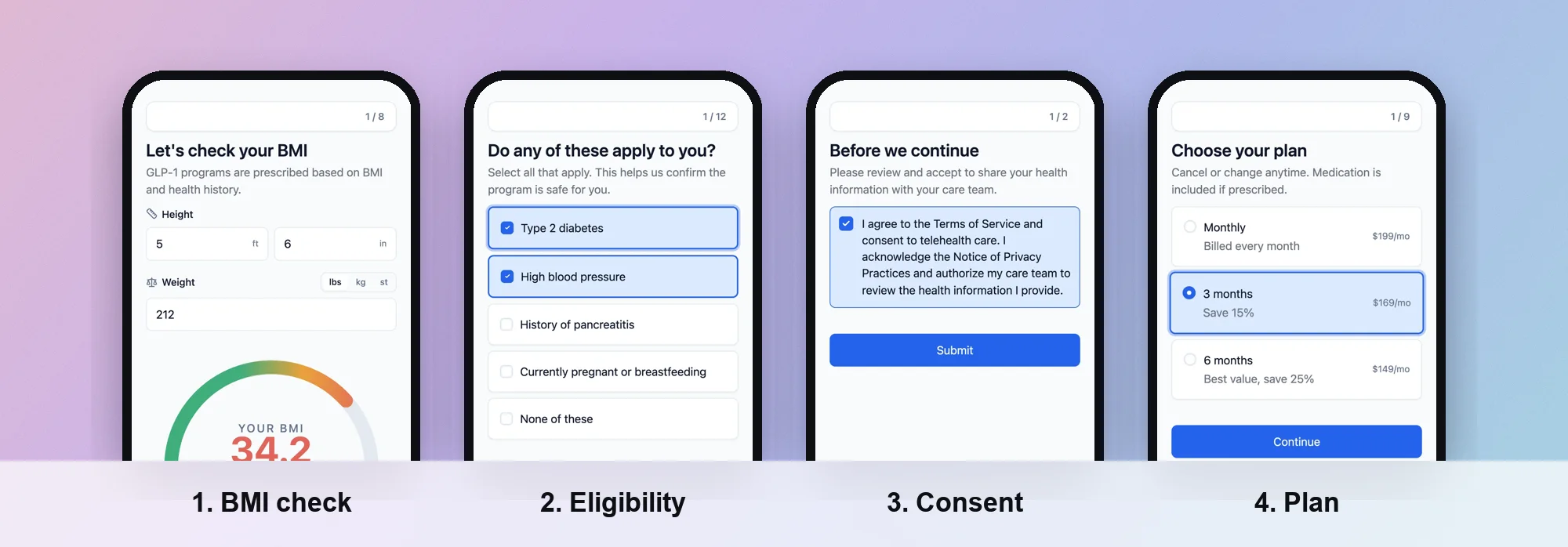 The core of a GLP-1 flow, built in PathwAI: BMI check, eligibility screen, consent, plan.
Make BMI live, not a hidden gate
Calculate BMI as the person types and show it on the same screen, with a line like “Your BMI helps our clinicians decide which options fit you”. A hidden calculation that silently ends the flow feels like a trick. Accept pounds or kilograms, feet and inches or centimeters, and validate ranges so a typo does not disqualify anyone.
Ask hard stops early, soft flags later
Split your clinicians’ rules into two lists. Hard stops (such as MTC or MEN 2 history, if they treat it as an exclusion) go in step 3. Soft flags (a past gallbladder problem, a current medication) go in the intake, as context for the prescriber instead of an ending.
Routing people who do not qualify
Someone who does not qualify should never hit a blank “Sorry” screen. Decide, with your clinicians, what each “no” leads to:
- BMI below your threshold. A clear explanation, and if you have one, a non-medication program (nutrition coaching, a membership) or an email list.
- A contraindication. A plain message that this treatment is not a fit, and a suggestion to talk to their own doctor.
- Location. A waitlist for their state, so you can reach them when you are licensed there.
- Needs review. Some answers are not a yes or a no. Route them to intake with a flag for the prescriber instead of guessing.
“Based on your answers, this program is not the right fit right now” reads better than “You are ineligible”, and it is just as true.
Compounded vs branded: be careful with the copy
If your program offers compounded semaglutide or tirzepatide, the copy on your plan and checkout steps carries real regulatory risk.
- The FDA states that compounded drugs are not FDA-approved and that the agency does not review them for safety, effectiveness or quality before they are marketed. It lists claims that a compounded drug “is the same as an FDA-approved drug” as a red flag.
- On March 3, 2026, the FDA announced 30 warning letters to telehealth companies over compounded GLP-1 marketing. The violations named were claims implying sameness with FDA-approved products, and branding drugs with the telehealth company’s name without saying who made them. Compounded drugs are also not generics, the FDA notes.
- The FDA has determined that the shortages are resolved: tirzepatide on December 19, 2024 and semaglutide on February 21, 2025. Copy that leans on a shortage is out of date.
In practice: never write “same as Wegovy” or “generic Ozempic” on a plan card, say clearly which product is FDA-approved and which is compounded, and have counsel approve every word on the plan and checkout steps.
Measuring drop-off per step
An overall conversion rate tells you people leave, not where. Track:
- For every step, how many people reached it and how many left on it.
- How many people were routed to each “not eligible” ending, and which answer sent them there.
- Time from first screen to checkout, and to clinician review.
Read the numbers with your clinicians. If the eligibility screen sends far more people to a “not a fit” ending than they expected, check the rule and its wording before you blame the ads. If people leave on medical history, split it into phases. If they leave at checkout, test the plan cards. Change one thing at a time against the current version.
Keep ad pixels off the health screens. Our HIPAA-ready intake playbook explains why a pixel on a screen where someone ticks “type 2 diabetes” sends health information to an advertiser.
Build it in PathwAI
PathwAI is an AI-native builder for intake flows, eligibility quizzes and checkout funnels for health brands.
- Start from the template. The GLP-1 eligibility and intake template already has the BMI check, eligibility screen, consent and plan-and-checkout steps. Edit every question and rule before it goes live. The weight-loss and GLP-1 page shows the full use case.
- Build and route on one canvas. In the builder, eligibility, intake, consent and checkout are steps on one visual canvas. Routing rules branch on any answer or combination of answers: eligible people continue, others get a custom message, a waitlist or another treatment path. Fields include a BMI calculator and medication lists.
- Consent and checkout. Consent is a step patients acknowledge before continuing, timestamped and stored with the answers. Steps can take payment through Stripe or Authorize.Net, book through Cal.com and verify ID through Persona.
- Draft with AI. Describe the program in plain English and the AI agent drafts the steps, copy and routing. Your team reviews it, consent wording goes to your clinical or legal team, and nothing publishes without approval. No patient data is used in the prompts.
- See every step. Step-level analytics and A/B tests show completion and drop-off for each screen, and let you test copy, step order or routing against a control.
- Attribute ads without pixels. The Data Platform sends conversions server-side to Meta, Google Ads, TikTok and Microsoft Ads, with email and phone SHA-256 hashed and health data stripped, and only for visitors who consented. Conversions are attributed to the ad, campaign and keyword from the click ids and UTMs captured on the visit.
PathwAI signs a BAA on its Enterprise plan. It is not an EHR, and it does not decide who is eligible: your clinicians set the rules, and the flow applies them.
Checklist before you launch
- Your clinicians have written down every eligibility rule, split into hard stops and flags for review.
- The goal question comes first, and BMI is calculated live and shown on screen.
- Hard stops come before the medical history; soft flags go to the prescriber.
- Every “not eligible” path has its own ending, waitlist or alternative.
- Consent has its own step and is recorded with the answers; marketing opt-in is separate.
- Plan and checkout copy never implies a compounded drug is the same as an FDA-approved one, and counsel has approved it.
- The last screen says who reviews the intake and when.
- You can see drop-off for every step, and no ad pixel runs on a health screen.
Frequently asked questions
What BMI should a GLP-1 eligibility quiz use?
Whatever your clinicians set. The Wegovy and Zepbound labels describe adults with obesity, or overweight with at least one weight-related condition, and their trials enrolled adults with a BMI of 30 or more, or 27 to under 30 with such a condition. The threshold is a clinical decision.
Which contraindications should the quiz screen for?
At minimum, the ones in the prescribing information: a personal or family history of medullary thyroid carcinoma or MEN 2, and a known hypersensitivity to the drug. Pregnancy and the labels’ warnings (pancreatitis, gallbladder disease, severe gastroparesis and others) are worth asking too. Your clinicians decide which end the flow and which go to review.
Should payment come before or after the clinician review?
You can take payment at the end of the flow and refund or release it if the clinician does not prescribe, or collect payment only after approval. Whichever you choose, say it plainly on the checkout and “what happens next” screens, so nobody thinks they bought a prescription.
Can I run Meta or Google ads to a GLP-1 quiz?
Yes, but do not put a third-party ad pixel on the screens where people answer health questions. Send conversions from the server with hashed identifiers, only for people who consented, and keep health answers out of every event.