
Best Formsort alternatives for digital health companies (2026)
Eight Formsort alternatives for digital health teams, compared on BAA plan, published price and fit, with fair limitations and when to stay on Formsort.
Written for operators, growth leads and product managers at telehealth and digital health companies
The best Formsort alternative for a digital health company depends on what you use Formsort for. If it runs your patient intake as a funnel (eligibility, intake, consent, checkout and ad attribution), PathwAI is built for exactly that job. If you only need HIPAA forms at a published price, Jotform Gold or IntakeQ cost less. If your engineers have built deeply on Formsort’s data model and you already hold its Enterprise BAA, staying put is often the right call.
Below are eight alternatives, what each vendor says on its own site about HIPAA and pricing, a fair limitation for each, and a section on when not to switch.
Quick picks
| Tool | Best for | HIPAA or BAA, per the vendor | Published starting price |
|---|---|---|---|
| PathwAI | Telehealth and DTC health brands running intake as an acquisition funnel | BAA on Enterprise | Quote (usually starts with a pilot) |
| Heyflow | Marketing teams building lead funnels | Not verified this run | Not verified this run |
| Feathery | Teams with complex, logic-heavy forms in regulated industries | Says it is HIPAA compliant; BAA not stated on the pages we read | Free plan; paid plans on quote |
| Fillout | Low-cost, general-purpose forms | No HIPAA or BAA on its pricing page | $15/month (Starter) |
| Jotform | Simple HIPAA forms, quickly | HIPAA features on Gold and Enterprise | $129/month, or $99/month billed annually (Gold) |
| Typeform | Brand-led forms at large companies | HIPAA on Enterprise only | Quote for Enterprise |
| FormDr | Practices replacing paper and PDF packets | ”HIPAA Compliant with BAA” on its Complete plan | Quote |
| IntakeQ | Solo and small practices | BAA listed on its Forms Only plans | $54.90/month (Forms Only) |
Prices and plan details come from each vendor’s own website, checked in October 2026. They change often, so confirm before you sign.
What is Formsort, and why do teams look for alternatives?
Formsort is a form and flow builder. Its site describes it as a low-code tool that lets product managers, marketers and designers change forms without engineers, and it lists healthcare first among the industries it serves. It is popular with digital health companies because it handles long, branching flows and gives teams fine control over how answers are structured and where they are sent.
Formsort’s pricing page lists three plans:
- Free: $0, with 100 flow starts a month and Formsort branding.
- Pro: $279 a month, with 1,000 flow starts a month and $239 for each additional 1,000.
- Enterprise: custom pricing. HIPAA compliance is listed as an Enterprise feature, and Formsort’s FAQ says it signs a BAA with enterprise clients.
That structure explains most of the switching conversations we hear. A health brand collecting PHI needs a BAA, so in practice it needs Enterprise. Pricing by flow starts also means cost grows with ad traffic, including visitors who leave on the first screen. And Formsort is a form layer: payment, ad attribution and conversion reporting usually live in other tools that your engineers connect.
None of that makes Formsort a poor choice. It means the right alternative depends on which of those three pressures you feel. For a side-by-side with two common general builders, see our comparison of Typeform, Jotform and Formsort for healthcare.
How we compared
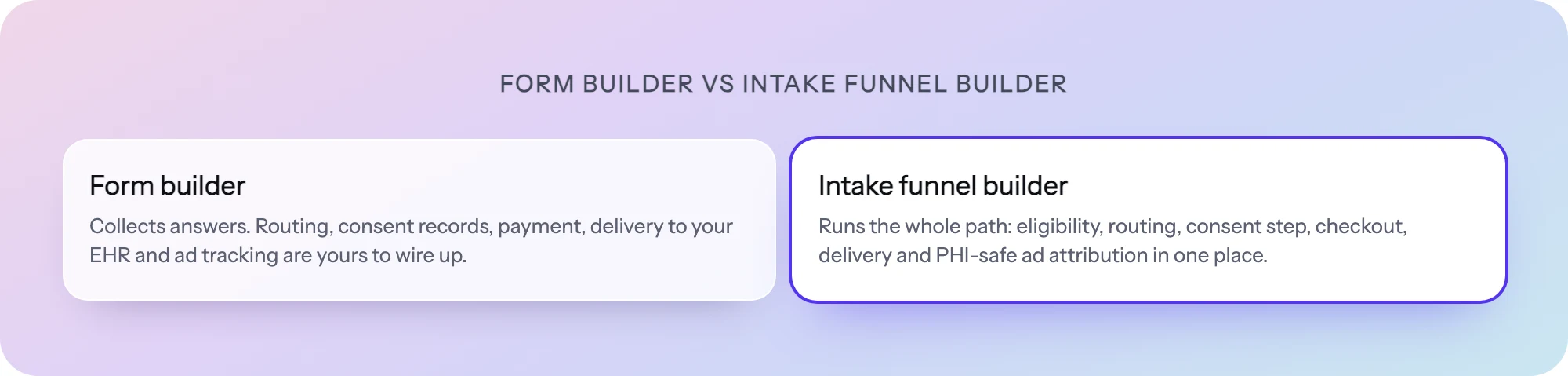
We read each vendor’s own pricing, security and compliance pages in October 2026 and recorded four things:
- BAA and HIPAA. Does the vendor say it signs a BAA, and on which plan? If a page could not be loaded, we say so rather than guess.
- Published price. The cheapest plan that matters for health data, where a price is public.
- Who it is for. The audience the vendor names, not the one we assume.
- Intake fit. Whether the tool covers the parts of a digital health funnel that sit beyond the form: eligibility routing, consent records, checkout and ad attribution.
The distinction in the figure above is the one that matters most. A form builder collects answers. An intake funnel builder also decides who is eligible, records consent, takes payment, delivers the result to your care team and reports the conversion back to your ad platforms without sending them health data. Formsort sits between the two: very capable on the form, with the rest assembled around it.
The 8 best Formsort alternatives
1. PathwAI
Best for: telehealth and DTC health brands that turn ad traffic into patients.
PathwAI is an AI-native patient acquisition platform. An AI agent builds the intake flow, eligibility quiz or checkout funnel from a plain-English description, and your team reviews and approves the draft before anything publishes. See how the AI agent drafts a flow.
What it covers:
- One canvas for the whole funnel. Eligibility, intake, consent and checkout steps sit on the visual builder. Routing rules branch on any answer or combination of answers: eligible patients continue to intake and checkout, ineligible patients get a custom message, a waitlist or another treatment path. Eligibility criteria come from your clinicians.
- Consent as a step. Patients must acknowledge before continuing, and consent is timestamped and stored with the intake data.
- Checkout and more inside the flow. Steps can take payments (Stripe, Authorize.Net), book appointments (Cal.com), verify ID (Persona) and analyze a photo with AI Scan.
- Ad attribution without pixels. The built-in Data Platform sends conversions server-side to Meta, Google Ads, TikTok and Microsoft Ads. Email and phone are SHA-256 hashed, PHI such as date of birth and condition is stripped, and events go only for visitors who consented. No third-party ad pixels run in the flow.
- Step-level analytics and A/B tests. Completion and drop-off for every screen, and tests of copy, step order or routing that non-technical teams can run. More on analytics and A/B testing.
- Compliance. BAA on the Enterprise plan. Encryption in transit and at rest. Not SOC 2 certified at this time.
Limitation: PathwAI has no public list price; pricing is scoped to volume, integrations and compliance needs, and usually starts with a short pilot. It is built for health acquisition funnels, so a team that needs general-purpose forms across many departments will find it narrower than a horizontal form tool. It is not an EHR.
For a direct look at the two products, see PathwAI vs Formsort.
2. Heyflow
Best for: marketing teams and agencies building multi-step lead funnels for paid traffic.
Heyflow is a funnel builder aimed at conversion: visual, multi-step pages that turn ad clicks into leads.
We could not load Heyflow’s pricing or compliance pages when we checked this run, so we do not quote its plans, prices or BAA terms here. Ask Heyflow for its current BAA and the plan it names before you send it PHI.
Limitation: Heyflow is built as a general lead funnel tool across many industries. For a telehealth flow that must route on eligibility, store consent and report conversions without health data, compare the details carefully. Our PathwAI vs Heyflow comparison goes through them.
3. Feathery
Best for: teams that need complex, logic-heavy forms and care about where data is hosted.
Feathery’s security page says it is HIPAA compliant and SOC 2 audited, with a SOC 2 report available on request, and that form data can be hosted and processed in regions including the US, EU, Canada and Australia. Its pricing page lists a Free plan, with Growth and Business plans on custom pricing.
Limitation: Feathery now describes itself as an AI operating and decisioning system for financial services teams, and its solution pages focus on wealth management and insurance. Healthcare is not its main market. We did not find a BAA mentioned on the pages we read, so ask for one and the plan it covers. Like Formsort, it is a form layer: payment and ad attribution need other tools.
4. Fillout
Best for: low-cost, general-purpose forms where no PHI is collected.
Fillout’s pricing is public and low. The Free plan includes 1,000 responses a month. Paid plans are $15 a month (Starter, 2,000 responses), $40 (Pro, 5,000 responses) and $75 (Business, unlimited responses), with lower prices billed annually. An Enterprise plan offers custom agreements. Fillout says it is SOC 2 compliant, and its help center describes an Enterprise option that stops it storing form submissions on its own servers.
Limitation: Fillout’s pricing page does not mention HIPAA or a BAA on any plan. Treat it as a tool for marketing forms, waitlists and surveys that do not ask health questions, unless Fillout gives you a signed BAA.
5. Jotform
Best for: clinics and small teams that want HIPAA forms quickly at a published price.
Jotform’s HIPAA page says its Gold and Enterprise plans include HIPAA features, and that covered entities who enable HIPAA compliance in their account receive a signed BAA. Its pricing page lists Gold at $129 a month, or $99 a month billed annually. Starter, Bronze and Silver do not include HIPAA.
Limitation: Jotform is a form builder first. Long branching flows, a checkout designed as part of a treatment funnel, and server-side ad conversions are outside its core. Fine for an intake packet; harder to run as a paid acquisition funnel you test week to week.
6. Typeform
Best for: large companies that want polished, brand-led forms and already use Typeform elsewhere.
Typeform’s pricing page lists HIPAA only on the Enterprise plan, alongside SSO, GDPR compliance and a choice of US or EU data center. Its self-serve plans do not mention HIPAA.
Limitation: to collect PHI you need Enterprise, which is priced by quote, so the low entry price of its self-serve plans does not apply to health data. Typeform is strongest on the look of one question at a time; eligibility routing, consent records and checkout across a long intake are not its focus.
7. FormDr
Best for: practices replacing paper and PDF intake packets.
FormDr (FormDoctor) prices by quote. Its pricing page lists a Complete plan marked “HIPAA Compliant with BAA” and an Enterprise plan with custom BAA and SLA terms. It names its audiences plainly: solo practitioners and single-location practices, group practices, and health systems and provider networks. Plans include unlimited forms and packets, e-signatures and automated appointment reminders.
Limitation: FormDr is built for practices with existing patients and appointments, not for DTC brands acquiring patients from ads. Funnel features such as eligibility-driven checkout and ad conversion reporting are not what it is designed for.
8. IntakeQ
Best for: solo and small practices that want intake forms, and possibly practice management, at a low monthly price.
IntakeQ’s pricing page lists a Forms Only plan at $54.90 a month and a Practice Management plan at $84.90 a month, with a charge per additional practitioner. There are lower-cost low-volume versions: Forms Only at $29.90 a month, limited to 10 form submissions a month. Both Forms Only plans list a HIPAA BAA. Free trials need no credit card.
Limitation: IntakeQ is priced and built per practitioner, for practices that see their own clients. A telehealth brand running thousands of anonymous visitors through an eligibility quiz before any clinician is involved will find it the wrong shape.
When to stay on Formsort
Switching has a cost, and Formsort is a strong product. Stay if:
- You already hold Formsort’s Enterprise BAA and the contract works for your volume.
- Your engineers built around it. If your data pipeline, EHR sync and analytics depend on Formsort’s answer structure, rebuilding them is real work.
- Your funnel is mostly a form. If payment, attribution and consent are handled well elsewhere, a funnel platform may add little.
- Product owns the flow and has engineering time. Formsort’s flexibility pays off most when someone technical maintains it.
Look harder at an alternative if your team waits on engineers for routine flow changes, if cost per flow start grows faster than patients, or if you cannot see which ad campaign produced which approved patient. For a wider view of the category, see our list of the best HIPAA-compliant form builders.
How to move a Formsort flow to PathwAI
If your Formsort flow is a patient acquisition funnel, here is how a move typically runs in PathwAI.
- Describe the program. Write down the treatment, who it is for, the eligibility questions your clinicians set, and what happens to ineligible patients. Paste that into the AI agent. It drafts the steps, patient-facing copy and routing. No patient data is used in the prompt.
- Check the routing on the canvas. Open the draft in the builder and compare each branch with your Formsort flow. Routing rules can combine answers, for example a BMI threshold together with a contraindication question.
- Add consent and checkout. Add a consent step (your clinical or legal team reviews the wording) and a payment step with Stripe or Authorize.Net. Add booking or ID verification if the program needs it.
- Connect where data goes. Send intakes on to your EHR, CRM or webhooks through the integrations, and turn on the Data Platform so conversions go to Meta, Google, TikTok and Microsoft server-side, hashed and consent-gated.
- Review with the team. Share a preview link with clinical, legal and growth reviewers. Nothing publishes without explicit approval.
- Publish on your domain. Run the flow on your own domain or embed it on your site, then watch step-level drop-off and set up your first A/B test against the old flow.
Most teams ship a working first draft within a day or two of their demo call. If you want to see your own flow rebuilt, get in touch or read how PathwAI compares with Formsort.
Checklist before you switch
- Get the new vendor’s BAA in writing, on the plan you will actually pay for.
- List every place Formsort sends answers today (EHR, CRM, warehouse, webhooks) and confirm each has a BAA or receives no PHI.
- Export your current flow’s questions, routing logic and consent wording, and have clinicians re-approve eligibility criteria.
- Make sure no third-party ad pixel runs on pages where patients enter health information.
- Decide how conversions reach your ad platforms, and that no health data travels with them.
- Run the old and new flow side by side and compare step-level drop-off before you move all traffic.
- Complete the new flow yourself on a phone, including payment.
Frequently asked questions
Does Formsort sign a BAA?
Yes, on Enterprise. Formsort’s pricing page lists HIPAA compliance as an Enterprise feature, and its FAQ says it signs a BAA with enterprise clients. Its Free and Pro plans do not include HIPAA.
What is the cheapest Formsort alternative that signs a BAA?
Among the tools we checked, IntakeQ’s Forms Only plan ($29.90 a month on low volume, $54.90 a month otherwise) and Jotform Gold ($99 a month billed annually) have the lowest published prices for a plan with a BAA, as of October 2026. Both are form tools, not acquisition funnels.
Is Fillout HIPAA compliant?
Fillout’s pricing page does not mention HIPAA or a BAA on any plan. It says it is SOC 2 compliant. If you need to collect PHI, ask Fillout directly for a BAA before you rely on it.
Can I move my Formsort flow without engineers?
In PathwAI, an AI agent drafts the flow from a plain-English description and your team edits routing, consent and checkout on a visual canvas. You will still want someone to connect downstream systems such as your EHR, and your clinicians to re-approve eligibility criteria.
Is Formsort still a good choice?
For many teams, yes. If you hold its Enterprise BAA, your engineers have built on its data model, and payment and attribution are solved elsewhere, Formsort remains a capable form layer.
PathwAI publishes this guide and is one of the tools listed. Details for other vendors come from their own websites as of October 2026 and can change; confirm them with each vendor before you sign.