
How to build a TRT and HRT intake flow: structure, labs and consent
How to structure online intake for men's TRT and menopause HRT: symptoms, goals, history, labs and kits, consent, checkout, clinician review and DEA notes.
Written for operators and growth leads at men's health, women's health and hormone telehealth brands
A TRT or HRT intake flow should run in this order: symptoms, goals, medical history and contraindications, labs, consent, plan and checkout, then asynchronous clinician review. Men’s testosterone therapy and women’s menopause hormone therapy share that skeleton, but they differ in where labs sit, which history questions decide the route, and how a controlled substance changes the paperwork. Your clinicians set the eligibility criteria; the flow’s job is to collect what they need, in an order patients will finish.
What is a TRT or HRT intake flow?
It is the online path a patient takes from an ad or your website to a prescriber’s review. It replaces a static form with one question per screen, routing that depends on answers, and a clear handoff to labs, payment and the clinician.
Two programs usually sit under the “hormone” label:
- Men’s testosterone replacement therapy (TRT). Usually marketed around energy, libido, mood and body composition. Testosterone is a controlled substance in the US, and lab values play a large part in the clinical decision.
- Women’s menopause hormone therapy (HRT or MHT). Usually framed around hot flashes, sleep, mood and vaginal symptoms during perimenopause and menopause. Estrogen and progesterone products do not appear on the DEA’s controlled substances list, and the history questions (reproductive status, personal and family history) carry more of the routing weight.
How the two flows differ
The biggest structural difference is when labs happen.
In TRT flows, labs usually come before or alongside the clinician’s decision. The American Urological Association’s guideline on testosterone deficiency says care should focus on “accurate assessment of total testosterone levels, symptoms, and signs” and on-treatment monitoring (Mulhall et al., J Urol 2018). In practice, that means the flow either orders an at-home kit or asks for recent results before a prescription is considered.
The menopause flows we studied lead with symptoms and medical history, and whether labs are needed for a given patient is the clinician’s call. That is a clinical choice, not a flow choice, so build the lab step so it can be switched on per route rather than hard-coded.
The second difference is tone. In the flows we studied, the men’s programs lead with performance and vitality. The women’s programs lead with symptom relief and reassurance, with judgment-free wording on sensitive questions.
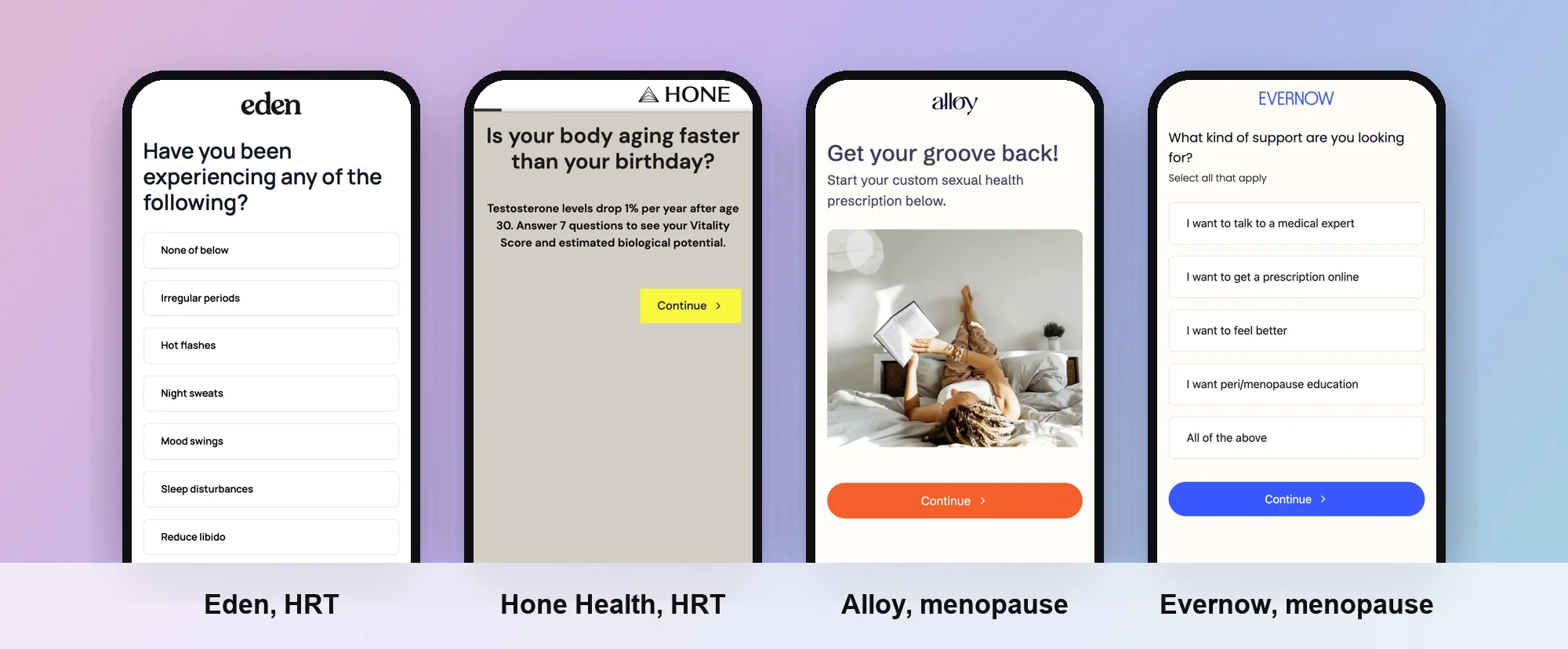 How four hormone programs open their intake. Screens from PathwAI’s rebuilds of the public flows; brand names and logos belong to their owners.
The step structure
1. Symptoms questionnaire
Open with symptoms, not demographics. A patient who has just ticked “poor sleep, low energy, brain fog” has told you why they came, and is more likely to keep going. Eden’s HRT flow, as we studied it, opens with one symptom checklist that captures the full range of menopause concerns in a single step. Alloy’s flow also leads with symptoms before any clinical question.
2. Goals
Ask what the patient wants from treatment. Hone Health’s quiz segments by age and then asks for goals, and uses that to personalize the educational copy that follows. Pandia’s menopause intake lets the patient pick a visit goal, which lets them steer their own path. Goals also give the clinician context and give you a segment for follow-up messaging.
3. Medical history and contraindications
This is the step that decides routing. Your clinicians write the list of conditions, medications and history items that make a patient ineligible or need a closer look. The flow’s job is to:
- Ask them as short yes/no questions, which keeps a long screen fast on mobile.
- Route a “yes” on a hard exclusion to a respectful exit (a message, a referral, or a waitlist), not a dead end.
- Route a “yes” on a soft flag to a follow-up question or to clinician review, not straight to rejection.
Eden’s flow, as we studied it, layers medical screening so contraindications are flagged early while eligible patients keep moving. Menopause flows also ask reproductive status (stage, periods, surgical history), because the clinician needs it to choose a regimen. Ask for state of residence early in both programs: prescribers are licensed by state, and Pandia’s intake collects state in its demographics.
4. Labs and at-home lab kits
You have three options, and many programs offer more than one:
- Order an at-home kit from the flow. The patient enters a shipping address and the order is placed when they reach or leave the step.
- Upload recent results. A file upload step for a lab report from the last few months, if your clinicians accept that.
- Send the patient to a lab draw after checkout, with the clinician review waiting on results.
Hone Health’s checkout, as we studied it, bundles testing, consultation and a treatment plan into one price, which makes the lab part of the purchase rather than an extra step later.
5. Consent
Put consent where patients read it: after they understand what they are buying and before payment. Typical acknowledgments are telehealth consent, the treatment’s risks and benefits as your clinicians describe them, privacy terms, and for TRT, anything specific to a controlled substance your counsel requires. Each acknowledgment should be its own checkbox, stored with a timestamp. Your clinical or legal team writes and approves the wording.
6. Plan and checkout
Show a plan summary: what is included (labs, visit, medication if prescribed, follow-up), the price and the billing interval. Make clear that a prescription depends on clinician review. Evernow’s flow, as we studied it, verifies insurance mid-flow to set cost expectations before the commitment step, then ends with calendar booking. Cash-pay programs usually end with a subscription checkout instead.
7. Async clinician review
After payment, the intake goes to a clinician, who reviews answers and labs, asks follow-up questions if needed, and decides. The flow should hand over a clean record (answers, consent timestamps, uploaded files, lab order status) and tell the patient what happens next and when.
Step by step: men’s TRT vs menopause HRT
| Step | Men’s TRT | Menopause HRT |
|---|---|---|
| Symptoms | Energy, libido, mood, strength; optional ADAM questionnaire | Hot flashes, sleep, mood, vaginal symptoms; optional Menopause Rating Scale |
| Goals | Energy, performance, body composition, fertility plans | Symptom relief, sleep, long-term health |
| Medical history | Clinician-set exclusions, current medications, fertility intentions | Reproductive stage and surgical history, personal and family history items your clinicians set |
| Labs | Usually required before a prescription; at-home kit or lab draw | Ordered when the clinician decides; switchable per route |
| Consent | Telehealth, treatment risks, controlled-substance terms from counsel | Telehealth, treatment risks and benefits |
| Plan and checkout | Often bundles labs, visit and plan | Visit or membership, sometimes insurance check |
| Clinician review | Async review of labs and history; video visit where required | Async review; video visit where clinicians or the state require it |
Symptom questionnaires clinics use
Two validated, self-administered instruments come up most often. Use them only if your clinicians want them; they screen and track symptoms, they do not diagnose.
- ADAM (Androgen Deficiency in the Aging Male). Published in 2000, it was validated as a screening questionnaire for androgen deficiency in men over 40 and showed 88% sensitivity and 60% specificity against low bioavailable testosterone in the validation study (Morley et al., Metabolism 2000). As a screen, it flags men for testing; it does not confirm low testosterone.
- Menopause Rating Scale (MRS). Eleven symptoms, each scored from 0 (no complaints) to 4 (very severe), across psychological, somato-vegetative and urogenital sub-scales (Heinemann et al., Health Qual Life Outcomes 2004). It was designed to measure symptom severity and changes before and after treatment, so the same questions can be reused at follow-up.
If you embed a scored instrument, keep the exact wording and answer scale of the validated version, show the score to the clinician, and let your clinicians decide whether the patient sees it.
Regulatory notes to check with counsel
This is not legal advice. These are the points that change how a hormone flow is built.
- Testosterone is a Schedule III controlled substance. It is listed in Schedule III in the DEA’s controlled substances list. Prescribing it requires a DEA-registered practitioner and follows controlled-substance rules.
- Telehealth prescribing of controlled substances runs on temporary rules. The DEA and HHS extended the COVID-era telemedicine flexibilities through December 31, 2026 (Federal Register, fourth temporary extension). They allow prescribing without a prior in-person evaluation when the rule’s conditions are met. DEA proposed a special registration for telemedicine in January 2025; at the time of writing, the final rule has not been published. Check HHS’s telehealth prescribing page for the current status before you launch or change a TRT flow.
- State rules apply on top. Prescriber licensing, and in some states the visit type required, depends on where the patient is. Ask state early and route by it.
Build the flow so these can change without a rebuild: the video visit requirement, which states you serve, and the consent text should all be editable in one place.
Build it in PathwAI
PathwAI is an AI-native builder for intake, eligibility and checkout flows, with a built-in data platform for consent-gated conversion tracking. Here is how the structure above maps to it. See the HRT solution page for the overview.
- Canvas and routing. Build symptoms, goals, history, labs, consent and checkout on one visual canvas in the flow builder. Routing rules branch on any answer or combination, so a hard exclusion goes to its own ending, a soft flag goes to clinician review, and TRT and menopause can share early steps and split later. Your clinicians set the rules; the builder applies them.
- Questionnaires and uploads. Field types include multiple choice, yes/no, numeric, date, file upload, medication lists and screening instruments, so an MRS-style scale or a lab report upload is a step, not a custom form.
- At-home lab kits. The Junction integration places an at-home lab order from a flow step, sending the patient and shipping details from earlier answers. Lab results stay in Junction; PathwAI places the order and does not import them.
- Consent. Consent is a first-class step: patients must acknowledge before continuing, and each acknowledgment is timestamped and stored with the intake data.
- Checkout, booking and ID. Steps can take payment (Stripe, Authorize.Net), book a visit (Cal.com) and verify ID (Persona).
- Clinician review. The async consult setup collects the full picture before the clinician opens the case.
- Tracking without leaking health data. Hormone answers are sensitive. The Data Platform sends conversions server-side to ad platforms with SHA-256 hashed identifiers, strips health details before any event leaves, and only for visitors who consented. Our HIPAA intake playbook covers the rest.
Step-level analytics show where patients drop off, so you can test whether the lab step works better before or after the plan summary. PathwAI signs a BAA on the Enterprise plan.
Checklist
- Clinicians have written the eligibility rules, exclusions and soft flags for each program.
- Symptoms come first; demographics come after the patient has invested a few answers.
- State of residence is asked early and routes to states you serve.
- Every hard exclusion has a respectful ending, not a dead end.
- Any scored questionnaire uses the validated wording and scale.
- The lab step (kit, upload or draw) can be switched on per route.
- Each consent is its own checkbox, timestamped, with wording approved by your clinical or legal team.
- Checkout says clearly that a prescription depends on clinician review.
- Counsel has confirmed the current DEA telemedicine status for TRT.
- Ad conversions are server-side, hashed and consent-gated, with no answers sent.
Frequently asked questions
What is the best software to build a TRT online intake questionnaire?
Look for conditional routing, consent capture with timestamps, file upload for labs, a lab-kit ordering integration, payment, a BAA, and step-level drop-off analytics. PathwAI covers these in one AI-native builder. Whatever you choose, check each item against your own flow before you sign.
Do men need labs before TRT is prescribed online?
That is your clinicians’ decision. The AUA guideline places weight on measured testosterone levels as well as symptoms, which is why most TRT flows include an at-home kit, a lab draw or a results upload before review.
Should a menopause HRT flow ask for labs?
Only if your clinicians want them for that patient. Build the lab step so it can be turned on for specific routes instead of forcing it on everyone.
Can one flow serve both TRT and menopause HRT?
Yes, if you split early. A shared opening (sex, age, state) can route into two branches with their own symptoms, history and consent, then rejoin at checkout. Two separate flows are simpler to manage when the messaging differs this much.
Can telehealth providers prescribe testosterone without an in-person visit?
Under the DEA’s temporary telemedicine flexibilities, which run through December 31, 2026, a DEA-registered practitioner can prescribe Schedule II to V controlled substances without a prior in-person evaluation if the rule’s conditions are met. What happens after that date depends on a final DEA rule. Confirm the current status with counsel.