
Best EHRs and telehealth platforms for DTC health brands (2026)
EHRs, white-label telehealth platforms and clinician networks for cash-pay and DTC health brands, compared on fit, BAA and pricing, plus how intake connects.
Written for founders and operators of cash-pay and DTC telehealth brands choosing a clinical stack
There is no single best EHR for a direct-to-consumer health brand, because most brands are buying one of three different things. If you have your own clinicians, you need an EHR: Healthie, Akute and Cerbo are built for virtual-first and cash-pay programs. If you do not have clinicians yet, you need a clinician network or a white-label telehealth platform, such as OpenLoop, Wheel or Bask Health, which bring the doctors, the chart and the pharmacy routing with them.
Below are eleven platforms DTC and cash-pay brands use, with what each is best for, where it falls short, its BAA terms and its pricing.
Quick picks
| Platform | Category | Best for | Published pricing |
|---|---|---|---|
| Healthie | EHR | Virtual-first and cash-pay programs with their own clinicians | Yes, from $19/month |
| OpenLoop | Clinician network and white-label telehealth | Brands that need licensed clinicians in every state | Quote |
| Bask Health | White-label telehealth platform | Founders launching a prescription brand fast | Yes, from $499/month |
| Wheel | Clinician network and white-label telehealth | Larger consumer and enterprise programs | Quote |
| Akute Health | EHR | Digital health, direct primary care and wellness practices | Yes, from $300/month |
| Cerbo | EHR | Cash-based, functional medicine, IV and BHRT practices | Yes, per user |
| Canvas Medical | EHR and developer platform | Care companies with engineers building a custom model | Yes, from $4,000/month |
| Elation Health | EHR | Primary care and direct primary care | Quote |
| CharmHealth | EHR | Small practices that want a free or low-cost start | Yes, free tier |
| Practice Better | Practice management with EHR | Nutrition, coaching and functional medicine practitioners | Yes, free tier |
| DrChrono | EHR | Independent practices that want a mobile EHR | Quote |
Prices are as listed on each vendor’s own site in October 2026. “Quote” means no public price.
What these categories mean
Vendors here describe themselves in overlapping ways. Separate four jobs:
- EHR (or EMR). The clinical record: charting, e-prescribing, labs, scheduling, often billing and a patient portal. You bring your own licensed clinicians. Healthie, Akute, Cerbo, Canvas, Elation, CharmHealth, Practice Better and DrChrono sit here.
- White-label telehealth platform. Software that runs the patient side of a telehealth brand under your name: portal, prescription workflow, payments and links to pharmacies and doctor groups. Bask Health is the clearest example.
- Clinician network (provider-as-a-service). A medical group, licensed across states, whose clinicians review your patients and prescribe under protocols. The network usually brings its own EHR and patient portal. OpenLoop and Wheel combine a network with white-label technology.
- Pharmacy partners. Retail, mail-order or compounding pharmacies that fill and ship prescriptions. Most brands reach them through their EHR’s e-prescribing, a white-label platform’s pharmacy integrations, or their clinician network’s routing, rather than as a separate contract on day one.
A common first stack for a new GLP-1, HRT or peptide brand is an intake flow, a clinician network that brings its EHR, and pharmacy routing through that network. A brand that later hires its own clinicians may move to its own EHR account. Our peptide brand launch playbook walks through that sequence.
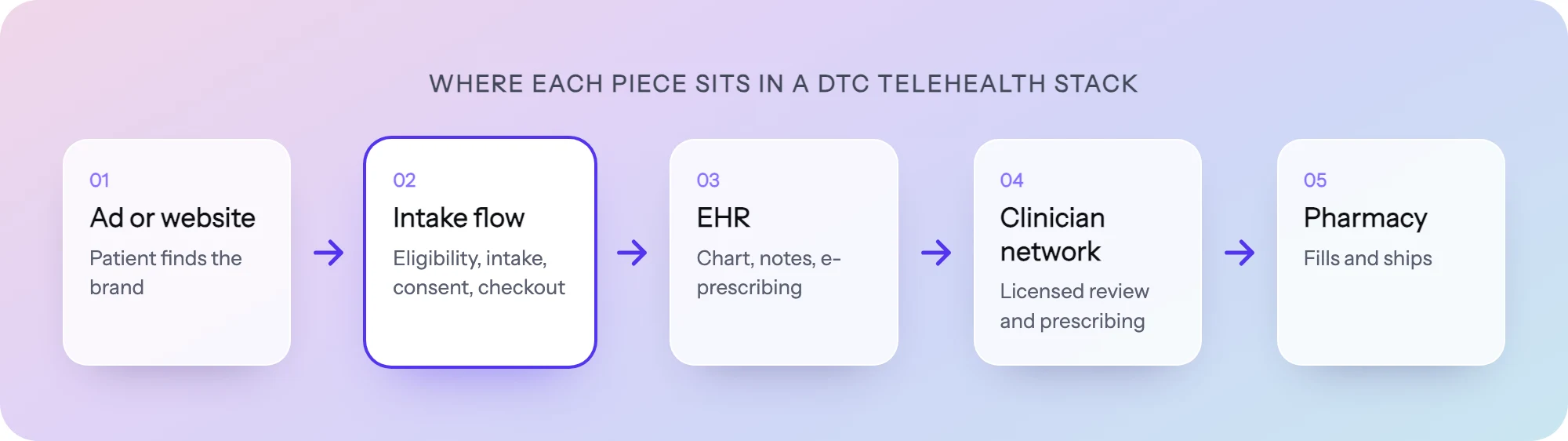 Where each piece sits. The EHR is the clinical record; intake is how a visitor becomes a patient.
How we compared them
We checked each platform on its own website for four things: what it says it is and who it serves, its category, whether it signs a Business Associate Agreement (BAA), and whether its price is published. Platforms whose BAA terms we could not confirm there were left out, and vendor statements are reported as their claims.
The platforms, one by one
1. Healthie
Best for: virtual-first and cash-pay programs that employ their own clinicians, from private practices to digital health startups and enterprises.
Healthie combines scheduling, charting, billing, telehealth and patient engagement in one platform. Its site names behavioral health, family care, women’s health, nutrition, coaching and chronic care, and it markets directly to digital health startups and enterprises.
BAA: Healthie says it signs a BAA; the Group plan includes a standard BAA and Enterprise a customized one. Healthie says it is HIPAA and SOC 2 compliant.
Worth knowing: API access costs extra, which matters if your intake, CRM or pharmacy logic lives outside Healthie.
Pricing: Core $19, Essentials $49, Plus $129 and Group from $149 a month on monthly billing.
2. OpenLoop
Best for: brands that want licensed clinicians, protocols and operations handled for them.
OpenLoop calls itself “the white-label operating system for virtual care”: your brand on the front, OpenLoop running the back. It offers a clinician network across 35+ specialties in all 50 states, an EHR and patient portal, a pharmacy and diagnostics network, care coaching and revenue cycle management. OpenLoop says it serves more than 400 virtual care brands. OpenLoop patients live in a Healthie account, which is why integrations with OpenLoop usually write to Healthie.
BAA: OpenLoop says it provides BAAs.
Worth knowing: you are buying a service relationship, not only software, so protocols, turnaround and state coverage are contract terms worth negotiating.
Pricing: quote only; OpenLoop says cost depends on the services you add.
3. Bask Health
Best for: founders who want a branded prescription business running quickly, with doctors and pharmacies already connected.
Bask describes itself as “The Platform for Telehealth” for entrepreneurs, doctors and developers. It bundles a white-label patient portal, an EMR with e-prescribing, pharmacy fulfillment and payments. On its Mini plan, Bask says you get 10+ pharmacy integrations and access to 3+ doctor groups; Growth raises that to 60+ pharmacy integrations and adds webhooks; Enterprise adds API access and the option to bring your own doctor groups.
BAA: Bask says its platform has business associate agreement coverage across the full system.
Worth knowing: webhooks start on Growth and the API only on Enterprise, so connecting outside tools (your own intake, CRM or analytics) on the entry plan is limited.
Pricing: Mini $499 a month, Growth $3,500 a month, Enterprise by quote.
4. Wheel
Best for: established consumer brands and enterprise programs that want a large clinician network behind their own experience.
Wheel offers a 50-state network of board-certified clinicians and its Horizon platform, which it calls “the complete infrastructure for modern telehealth”, in branded or white-label form. It lists consumer and DTC companies alongside pharma, health plans, retail and pharmacy as the groups it serves.
BAA: Wheel’s API terms say the parties enter into a BAA when an integration involves PHI.
Worth knowing: its customer list leans toward large partners, so a brand still validating demand may find the sales process heavier than a self-serve platform.
Pricing: quote only.
5. Akute Health
Best for: digital health platforms, direct primary care, concierge, medspa and wellness practices that want automation built in.
Akute calls itself “an automation-first EHR for modern care”, with e-prescribing, pharmacy integrations and telemedicine. Its pricing is per clinician and per active patient, which is easy to model for a new program.
BAA: Akute says it signs BAAs.
Worth knowing: plans include a fixed number of patients and charge for each one above it, so cost grows with patient volume, not only headcount.
Pricing: Essentials $300 a month (1 clinician, 100 patients), Premium $550 a month (2 clinicians, 300 patients), Developer by quote.
6. Cerbo
Best for: cash-based, functional and integrative medicine, direct primary care, IV and BHRT, and medspa practices.
Cerbo calls itself a “do-it-all EHR solution” and names cash-based practices, IV and BHRT among the five practice types it is built for. It emphasizes configurability, with membership management for direct care and ordering of prescriptions and supplements.
BAA: Cerbo publishes its Business Associate Agreement on its site.
Worth knowing: telemedicine and the patient portal are paid add-ons, and there is a one-time setup fee.
Pricing: published per user, for example $281 a month for a full-time prescribing provider, plus a $1,195 setup fee ($595 for new solo practices) and $27 a month per provider for telemedicine.
7. Canvas Medical
Best for: care companies with engineers who want to build their own clinical workflows on an EHR.
Canvas calls itself an AI-powered healthcare platform for clinics and offers APIs, plugins and agents for developers. Its Builder plan includes unlimited users, the first 1,000 monthly active patients, unlimited API calls and an 8-week onboarding. Canvas lists SOC 2 Type II and HITRUST among its certifications.
BAA: Canvas requires a signed BAA before PHI goes into the platform, as part of its sales order.
Worth knowing: it is priced and designed for teams that will build on it, which is more than most early DTC brands need.
Pricing: Builder $4,000 a month; Enterprise by quote.
8. Elation Health
Best for: primary care and direct primary care practices.
Elation calls itself an AI-native EHR platform for primary care, with charting, billing, a patient portal, telehealth and eligibility checks in one system.
BAA: Elation publishes its Business Associate Agreement on its site.
Worth knowing: it is built around primary care, so a single-condition prescription brand will use a fraction of it.
Pricing: quote only.
9. CharmHealth
Best for: small practices that want to start free and pay as volume grows.
CharmHealth offers an AI-enhanced EHR with practice management, billing, a patient portal and an integration marketplace, plus CharmTeleHealth for video visits.
BAA: CharmHealth says a BAA is available on its plans, on request to its support team.
Worth knowing: telehealth is an add-on at $20 per provider a month, and the free plan is capped at 50 encounters a month.
Pricing: Free plan, Encounter plan at $0.50 per encounter (minimum $25 a month), or Provider plan at $200 per provider a month.
10. Practice Better
Best for: nutritionists, dietitians, health coaches and functional medicine practitioners running programs online.
Practice Better combines client records, scheduling, programs and telehealth video. Its site lists mental health professionals, functional medicine practitioners, coaches, medical doctors and nurse practitioners among its users.
BAA: Practice Better says US practitioners can sign a BAA from their portal.
Worth knowing: plans are priced per practitioner and sized for practices, not for a brand routing thousands of patients through a medical group.
Pricing: from free (3 clients) to $155 a month for Team on monthly billing.
11. DrChrono
Best for: independent practices that want a mobile-first EHR with telehealth included.
DrChrono calls itself an all-in-one EHR platform with scheduling, documentation and billing, and includes telehealth in all three of its plans.
BAA: DrChrono’s BAA is part of its service agreement.
Worth knowing: its plans center on scheduled visits, documentation and claims billing, which is more practice management than a cash-pay prescription brand usually needs.
Pricing: quote only.
Where intake fits next to your EHR
An EHR’s intake forms are built for people who are already patients: they collect history before a visit. The first screen after an ad needs something else: an eligibility quiz, medical intake, consent and checkout in one guided flow, with routing for people who do not qualify and a way to see which step loses them.
PathwAI is not an EHR. It is an AI-native builder for that front part: intake flows, eligibility quizzes and checkout funnels on one visual canvas, running on your own domain or embedded on your site. When a patient finishes, PathwAI sends the result to the clinical side:
- Healthie, through OpenLoop. A flow step can create or update the patient in Healthie, so the clinician opens a record that already has the intake. See the Healthie integration.
- CarePortals. Flows connect to CarePortals for brands that run their store and consultations there. See the CarePortals integration.
- Anything else, by webhook. Completed submissions go as structured data to an endpoint you choose, so your own service or an automation tool can write them into another EHR. See webhooks.
PathwAI also handles what an EHR does not: server-side conversion tracking to Meta, Google, TikTok and Microsoft with identifiers hashed and health details stripped, only for visitors who consented, through its Data Platform. It signs a BAA on its Enterprise plan; see HIPAA. For how PathwAI compares with other intake tools, see our patient intake software guide.
How intake connects to your EHR
Whatever you pick, the handoff from intake to the chart needs three things:
- Structured data, not a PDF. Each answer should arrive as a field the EHR stores (height, weight, date of birth, medications, screening answers), not as a PDF a clinician retypes.
- A stable patient match. Match on one identifier, usually email, and update the existing record instead of creating duplicates.
- A defined trigger. Send when intake is complete and consent is recorded, and decide what happens for ineligible patients (usually nothing goes to the chart).
Two ways to do it: a native integration, where the intake tool calls the EHR’s API directly (as with Healthie), or webhooks, where the intake tool posts each completed submission as JSON to an endpoint and your engineer or an automation tool maps it into the EHR’s API. Webhooks work with any EHR that has an API; check whether yours includes API access on your plan.
Before launch, run a test patient through every ending and open each record in the EHR.
Checklist for choosing
- Clinicians: do you employ your own, or do you need a network? That decides EHR versus network or white-label platform.
- States: does the network or your own licensing cover every state you will advertise in?
- BAA: confirm the vendor signs one on the plan you will buy. HHS explains what a business associate is in its business associate guidance.
- Pharmacy routing: which pharmacies are connected, and can you add your own?
- API and webhooks: are they included on your plan, or only on a higher tier?
- Intake handoff: see a test intake arrive in the chart, as structured fields, before you sign.
- Clinical protocols: your clinicians, or the network’s, set eligibility criteria; make sure your intake asks exactly what they need.
Frequently asked questions
What is the best EHR for a DTC telehealth brand?
If you employ your own clinicians, start with Healthie for virtual-first programs, and look at Akute and Cerbo for cash-based and wellness practices. If you rely on a clinician network, you usually use the network’s EHR (OpenLoop works in Healthie) rather than buying your own.
What is the difference between a clinician network and a white-label telehealth platform?
A clinician network provides licensed clinicians who review and treat your patients. A white-label telehealth platform provides the software under your brand. Some vendors, such as OpenLoop and Wheel, offer both; Bask Health is software that connects you to doctor groups and pharmacies.
Can I use my EHR’s intake forms instead of a separate intake tool?
You can, but EHR forms are built for existing patients, and rarely support eligibility routing, checkout, A/B tests or step-level drop-off. Many DTC brands run intake in a dedicated tool and send the result to the EHR.
Do I need a BAA with my EHR and my intake tool?
If you are a HIPAA covered entity, or work with one, and the vendor stores or processes protected health information for you, yes. Every platform in this list says it signs one; check which plan includes it.
How much does an EHR cost for a telehealth startup?
Published prices in October 2026 range from free (CharmHealth, Practice Better) and $19 a month (Healthie Core) to $4,000 a month (Canvas Builder). Clinician networks such as OpenLoop and Wheel price by quote, because cost depends on the clinical services you use.
PathwAI publishes this guide and integrates with some of the platforms listed (Healthie through OpenLoop, and CarePortals). PathwAI is not an EHR and is not ranked here. Product details for other vendors come from their websites as of October 2026 and can change; confirm them with each vendor.